Grape variety
Beibinghong
北冰红běibīnghóng
The world's only grape bred for red ice wine, created in China
- Type
- Grape variety
- Colour
- red
- Family
- Native to the north-east
- Origin
- China: a hybrid of the wild Amur vine (Vitis amurensis) and European Vitis vinifera
- In China since
- Bred 1995, released 2008
- Main regions
- Heilongjiang, Liaoning
- Literal meaning
- Roughly 'northern ice red'
Taste profile
Body
LightFullBody: 3 out of 5Tannin
LowHighTannin: 2 out of 5Acidity
LowHighAcidity: 5 out of 5Fruit
SubtleIntenseFruit: 4 out of 5
Aromas
- red berries
- cherry
- honey
- dried fruit
- Red berries and cherry with the honeyed concentration of ice wine.
Sweetness · often sweet (red ice wine)
Red cherry, raspberry and wild berries, very fresh acidity, deep colour.
Beibinghong is a grape created in China to survive the extreme winters of the northeast. Bred by the Chinese Academy of Agricultural Sciences, it combines the cold resistance of the wild Amur vine, native to East Asia, with the quality of European grapes. It is the world's first and only grape variety bred specifically for red ice wine.
The wild ancestor
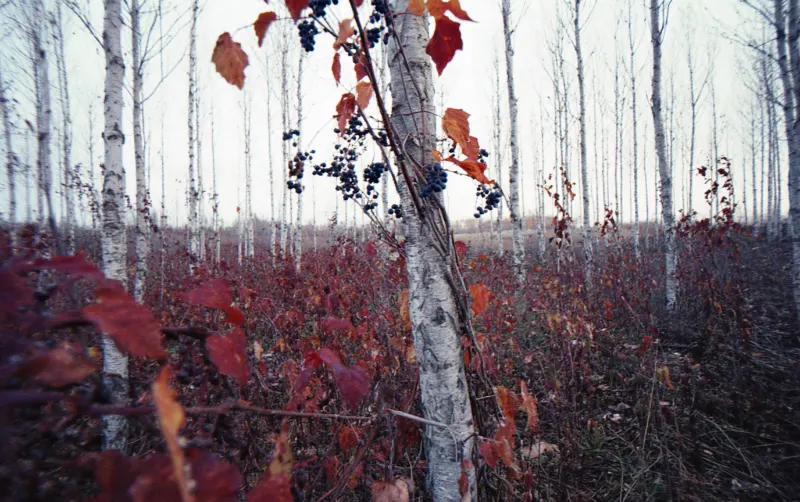
In the forests of China's north-east grows the Amur grape, Vitis amurensis, a wild vine that survives winters far colder than any European vine could. Its berries are small, deeply coloured and very acidic, but low in sugar.
A Chinese creation
Chinese scientists have long crossed the Amur grape with the European wine grape, aiming to combine cold resistance with wine quality and to reduce the need to bury vines in winter. Beibinghong is one of the results: a red grape made for the extreme cold of the north-east.
Red ice wine
Its most famous use is red ice wine, a rarity in the wine world, with deep colour and bright acidity.
History in China
In northeast China, winters are so cold and the frost-free season so short that European grapes such as Cabernet Sauvignon, Riesling and Chardonnay cannot ripen or survive. The native Amur vine, by contrast, can withstand –40 °C or lower, but its berries are very acidic and low in sugar.
Scientists at the Institute of Special Animal and Plant Sciences of the Chinese Academy of Agricultural Sciences, in Jilin, worked for generations of crosses between the two species. Beibinghong was created in 1995 by the breeder Song Rungang and, after years of testing, released in 2008. Unlike earlier Amur-based grapes, used only for sweet red wines, it can make both dry red and red ice wine.
Growing
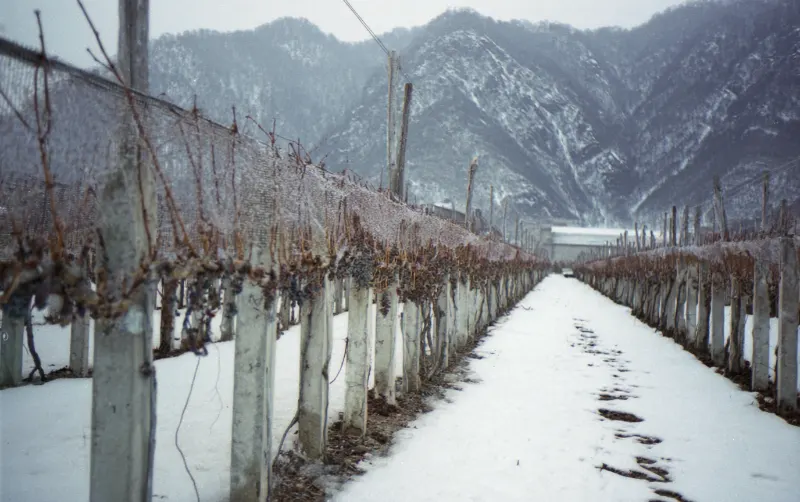
Beibinghong is highly resistant to cold, tolerating frost down to about –30 °C, and has good resistance to some mildew diseases, while giving high yields of good-quality grapes. It is grown mainly in northeast China, especially around Ji'an in Jilin, where the Changbai Mountains shield the vineyards from the north wind and the Yalu River brings milder air.
Where it grows in China
Pairs with
Food pairings
- A red Beibinghong ice wine with a red bean mooncake at the Mid-Autumn Festival is a pairing you will not find anywhere else in the world. It also suits berry desserts and chocolate.
Sources
- 'Beibinghong': a new grape cultivar for brewing ice red wine — Vitis (journal), 2014
- Phenolic and chromatic properties of Beibinghong red ice wine during and after vinification — Molecules, 2016
- A new ice-red brewing grape variety 'Beibinghong' (北冰红) — Acta Horticulturae Sinica, 2008
- China's ice wine pioneers taste sweet success — Asia Times, 2020
- Beibinghong — Wein.plus
Similar ingredients
马瑟兰
RED
Marselan
A French grape that may become China's signature
蛇龙珠
RED
Cabernet Gernischt
China's mystery grape, revealed by DNA to be Carmenère
小芒森
WHITE
Petit Manseng
A French white turning into one of China's most exciting wines
赤霞珠
RED
Cabernet Sauvignon
China's most planted red grape and the backbone of its best reds
美乐
RED
Merlot
The soft partner of Cabernet in China's Bordeaux-style blends
霞多丽
WHITE
Chardonnay
China's leading white grape, for still and sparkling wines