封缸酒
fēnggāng jiǔ
The sealed-vat wine of Jiangsu
3 min read
In 10 seconds
Amber, intensely sweet and sealed for years. China lists it as heritage in urgent need of protection.
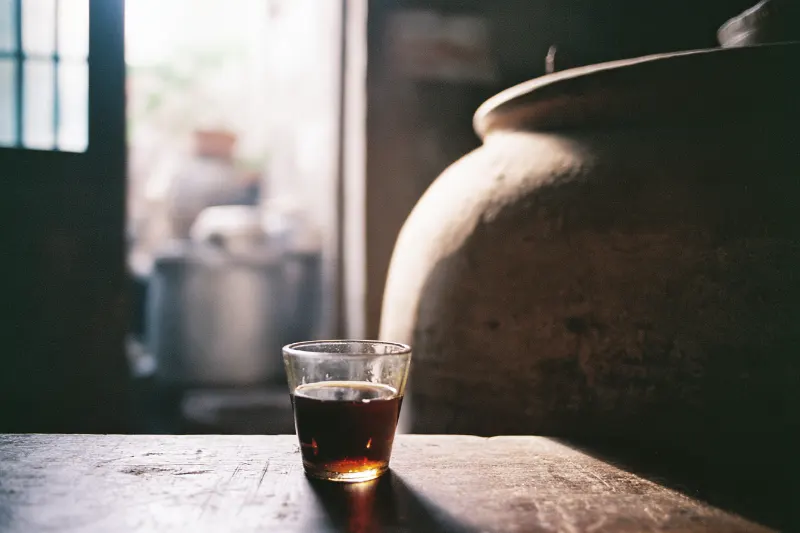
Pour it into a glass and it catches the light like old honey: red-brown, with an amber sheen. Bring it to the nose and the heritage record speaks of a rich aroma; on the palate, of something mellow and sweet with a fresh finish. This is 封缸酒 (fēnggāng jiǔ), "sealed-vat wine", from the south of Jiangsu, and few European dessert-wine lovers have ever heard of it.
Rice, spring water and patience
The craft is listed on China's national intangible heritage register, in the second batch of 2008. The declaring area is 金坛 (Jīntán), now part of Changzhou, and not 丹阳 (Dānyáng), even though both towns are famous for this wine. It is a small but telling detail: the listing belongs to one place, the reputation to two.
The base is local glutinous rice and spring water from 茅山 (Máoshān), Mount Mao. According to the heritage record, the washed and steamed grain is mixed with white qu, 白曲 (báiqū), a yeast mother, 酒母 (jiǔmǔ), further qu and water. It ferments, is pressed, and is then clarified in a step called 泼清 (pōqīng) and filtered.
Then comes the part that gives the wine its name. It goes into vats that are sealed, and it stays there for a long time.
A line of old praise
The heritage record quotes a classic couplet: "味轻花上露,色似洞中春" (wèi qīng huā shàng lù, sè sì dòng zhōng chūn). Loosely, "a taste as light as dew on a flower, a colour like spring inside a cave". It is a lovely paradox for a wine described as intensely sweet: lightness of touch, depth of colour.
The record traces the history of Danyang and Jintan sealed-vat wine back about 2,000 years, to the Qin and Han dynasties. That is the tradition's own account, as repeated by the official listing.
A taste as light as dew on a flower, a colour like spring inside a cave.
Why a sommelier should care
Seen from Italy, the obvious comparison is Vin Santo: amber, sweet, slowly aged in sealed containers. Tokaji comes to mind too. That parallel is ours, not the sources', but it is a fair way into the glass. Sealed-vat wine belongs, in spirit, to the same family of patient, meditative sweet wines, the kind you pour at the end of a meal and sip while the conversation slows down.
What it does not share with them is the raw material. There is no grape here. The sugar comes from rice starch, unlocked by moulds and yeasts in the qu, and the long rest in the vat does the rest. The sources consulted give no alcohol strength and no sugar figure, so neither is offered here.
Heritage in urgent need of care
The heritage record does something unusual for an official document: it worries. Changing diets have reduced demand for strongly sweet yellow wine, it says, and protection of the craft is described as urgent.
European readers who love sweet wines will recognise the worry. Wines like this tend to survive when people rediscover them as wines for meditation rather than for every day. Sealed-vat wine may need that kind of second life.
It is sold in China. Whether it reaches European shelves has not been verified, so finding a bottle may take some effort. For anyone who loves amber dessert wines, the search is worth it.
Sealed-vat wine is one of the sweetest expressions of Chinese rice wine, the vast family that runs from village jars to the aged wines of Shaoxing. To taste it is to see how far a grain of glutinous rice can travel, given time and a well-sealed vat.
How it's made
- Steam local glutinous rice.
- Ferment and press.
- Clarify the wine.
- Age it for years in sealed vats.
How it's drunk
Slowly, as a sipping wine.
Its European cousin
Like Vin Santo or Tokaji: amber, sweet and long-aged.