咂酒 · 杆杆酒
zājiǔ · gāngān jiǔ
Wine sipped through bamboo straws
3 min read
In 10 seconds
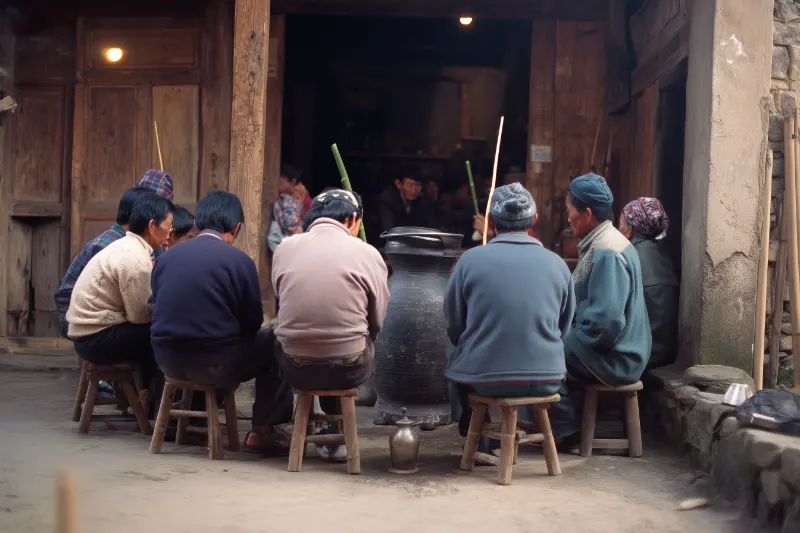
One jar, a circle of people, long bamboo straws. You keep adding water until the wine runs out, then you eat the grain.
The jar sits in the middle of the room. Around it, people take their places in a circle, the eldest first. Thin bamboo tubes rise from the jar like reeds from a pond, one for each drinker. Someone pours boiled water over the fermented grain, someone begins to sing, a drum answers. Nobody has a glass. In the mountains of western Sichuan, this is how a jar of wine is opened.
Barley, water and a bamboo tube
The drink is 咂酒 (zājiǔ), from a verb that means to suck or sip. Among the Qiang people of Sichuan it is made from cooked highland barley, 青稞 (qīngkē), mixed with starter and sealed in a jar for seven or eight days. What comes out is not a liquid to pour but a fragrant mass of fermented grain.
Drinking is where the craft becomes ritual. Boiled water goes into the jar, and the family drinks in turns through a thin bamboo tube, a 细竹管 (xì zhúguǎn). As the level drops, more water goes in. The wine grows paler and weaker with every round, until finally there is little left to sip and the grain itself is eaten.
连渣带酒水,一醉二饱 (lián zhā dài jiǔshuǐ, yī zuì èr bǎo): wine and lees together, first drunk, then full.
For a wine drinker it is a strange and lovely idea: a single vessel that gives several "pressings" of decreasing strength in the course of one evening, ending as food. Nothing is wasted, and the jar is finished only when the company is.
According to an ihchina.cn feature on Qiang food customs, 咂酒 appears at festivals, weddings, funerals and sacrifices, when guests arrive, and when neighbours swap labour in the fields. A secondary report adds the social rules: drinkers sit by seniority, songs go back and forth, drums keep time, and a guest is expected to drink "until the grain shows". The great occasion is the Qiang New Year, 羌年 (Qiāngnián), on the first day of the tenth lunar month. The festival, not the drink, was placed on UNESCO's list of heritage in need of urgent safeguarding in 2009.
The pole wine of Weining
Further south, in Weining 威宁 (Wēiníng) county in Guizhou, the Yi people make their own version. They call it 杆杆酒 (gāngān jiǔ), "pole wine", for the many tubes that stand in a single jar. The grain changes with the altitude: corn, buckwheat or bitter buckwheat, 苦荞 (kǔqiáo), sometimes with wheat. It is coarsely ground, steamed, cooled on a winnowing basket, mixed with buckwheat husks and sealed. The jar can be opened after about ten days, but local makers say it is better after two or three months.
Locals proudly call it 饮料中的茅台, "the Moutai of drinks". Local tradition also gives it a part in history: the rebel general Shi Dakai is said to have drunk it in 1861, and Liu Bocheng and Xiao Yedan are said to have sealed an alliance over it during the Long March. These are stories told about the wine, and they are best enjoyed as such.
Old poems, new cups
Drinking through a tube from a shared jar is old in China. A secondary source links it to a line by the Tang poet Du Fu, 芦酒多还醉, roughly "plenty of reed wine, and drunk again". The same source says the Ming scholar Yang Shen described reed-tube drinking and called it 钩藤酒 (gōuténg jiǔ), and that the Qing record 《黔记》 by 李宗昉 mentions 重阳酒 (chóngyáng jiǔ) drunk through a small bamboo tube. Those quotations still need checking against the original texts, but the thread is clear.
The Qiang still brew that 重阳酒 at the Double Ninth festival, ageing it for more than a year until it turns purplish-red. Yet habits are moving. The Yi now drink 杆杆酒 from bowls as well as tubes, and Qiang households increasingly reach for cups.
One honest note. This is a home-fermented, unregulated drink shared through common straws. It is a story to understand, not a recipe to copy.
Zajiu belongs to the wide, quiet world of Chinese grain and rice wines, fermented rather than distilled, made at home and drunk together. Next to the famous bottles of China, it is a reminder that some of the country's oldest wine traditions are measured not in years of ageing but in the number of people around a jar.
How it's made
- Cook highland barley, corn or buckwheat.
- Mix with starter and seal in a clay jar for about 7–8 days (the Yi version improves over 2–3 months).
- Open the jar and pour in boiled water.
- Drink in turns through bamboo straws, topping up with water until the wine is weak.
- Finish by eating the fermented grain.
How it's drunk
At the Qiang New Year (羌年), weddings and when guests arrive. Guests are expected to drink 'until the grain shows'.
Its European cousin
Like sharing mate through a bombilla in Argentina, but with wine.
A home-fermented, unregulated drink shared through common straws: enjoy it as a story, not as a recipe.