玉冰烧 · 九江双蒸
yùbīngshāo · jiǔjiāng shuāngzhēng
The spirit aged with pork fat
3 min read
In 10 seconds
In Foshan, rice spirit rests for about three months on a block of pork fat. It has been exported since 1917.
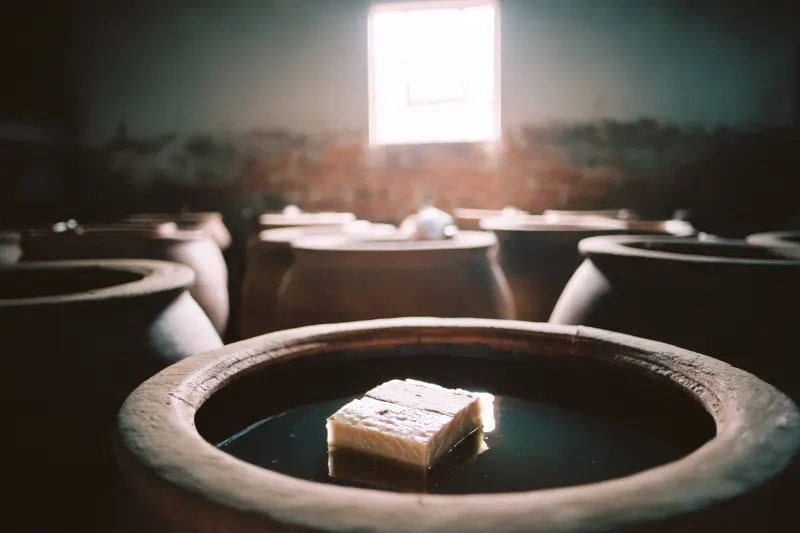
Every wine lover keeps a private list of things that should never go near a good drink. Pork fat sits somewhere near the top. In Foshan, in China's southern province of Guangdong, it is the whole point. For well over a century, distillers here have poured a light rice spirit into clay jars over fatty pork and left the two together for about three months. The fat stays behind. The spirit comes out clear and smooth, carrying a savoury note that Chinese drinkers have a word for.
A house, a grandson and a pun
The story belongs to Shiwan 石湾 (Shíwān) in Foshan, and to the 陈太吉 (Chén Tàijí) house, a distillery founded in 1830. In 1895 its third-generation head, 陈如岳 (Chén Rúyuè), created the spirit the house would be remembered for. It was first called 肉冰烧 (ròubīngshāo), "meat ice-burn". Honest, but hardly elegant.
Cantonese came to the rescue. In the local language 肉, meat, and 玉, jade, sound the same, so the drink quietly became 玉冰烧 (yùbīngshāo), "jade ice-burn". The pork stayed in the jar; only the name changed. The 陈太吉 house is the predecessor of today's 广东石湾酒厂集团, the Shiwan distillery group.
Its Foshan cousin is 九江双蒸 (jiǔjiāng shuāngzhēng), whose roots go back to the Daoguang era, from 1821. Its starter is made from rice and soybeans. The steamed rice is topped up and fermented a second time, then distilled. The young spirit is stored as 斋酒 (zhāijiǔ), the "plain" spirit, before it meets the pork in a step called 陈肉酝浸 (chénròu yùnjìn): steeping with aged meat.
What the fat actually does
The method fits into eight characters: 缸埕陈藏,肥肉酝浸 (gāng chéng chén cáng, féiròu yùn jìn), "aged in clay jars, steeped with fatty pork". According to Chinese reports on the craft, the fat slowly dissolves, adsorbs impurities and encourages esterification, the slow chemistry that builds aroma. The result is described as clean and smooth, with a 豉味 (chǐwèi): the scent of fermented black soybeans.
That note is strong enough to define a whole category. The style is called 豉香型 (chǐxiāngxíng), "fermented-bean aroma type", and it is counted as the sixth aroma type of baijiu.
The fat stays in the jar; each new batch of spirit is poured in on top of the last.
For a European with a sommelier's habits, the detail that lingers is the continuity. The fat is not thrown away after one use. Later batches of spirit are added to the same jar, so the vessel carries something of the previous spirit into the next one, a little like a solera carrying older wine into younger. Modern bartenders call the general technique fat-washing and use it to make bacon bourbon. In Foshan it has been part of the recipe since 1895.
Water from home
This is not an obscure village drink. Exports began in 1917, which makes it the earliest exported Cantonese liquor. In 1978 Foshan shipped more than 8,780 tonnes of rice spirit abroad. By 1988 it was on sale in the United States, the United Kingdom, Japan, Denmark, Canada, Singapore, Malaysia, Hong Kong and Macau. Both spirits are counted among Guangdong's "four famous liquors", alongside 长乐烧 and 飞霞液.
Cantonese communities overseas gave 九江双蒸 the most tender name of all: 故乡水 (gùxiāng shuǐ), "water from home". It is easy to picture why. A familiar bottle and a familiar savoury note, carried from southern China to tables in Denmark, Canada and beyond.
A few honest notes. Sources disagree on whether the craft is on a provincial or a national heritage list, so we leave that open. The strength is not reliably documented in what we have read. Whether you can buy either bottle in the EU today has not been verified. And for many readers the most important point: neither spirit is vegetarian or halal, because pork is part of the process.
Yubingshao sits at the rice-based, southern edge of baijiu, the huge family of Chinese grain spirits that most Europeans meet through the sorghum spirits of Guizhou and Sichuan. It is a useful reminder that baijiu is not one taste. It is dozens of local answers to the same question: what do you do to a spirit to make it your own?
How it's made
- Steam rice and ferment it with a rice-and-soybean starter.
- Distil to a light rice spirit.
- Pour the spirit into clay jars over aged pork fat (陈肉酝浸).
- Leave it for about three months; the fat stays in the jar and new spirit is added on top.
- Blend and filter before bottling.
How it's drunk
An everyday spirit in southern China and among Cantonese communities abroad, who call it 故乡水, 'water from home'.
Its European cousin
Bartenders call it fat-washing and use it for bacon bourbon. Foshan has been doing it since 1895.
Not vegetarian and not halal: pork fat is part of the process.