窨酒
yìnjiǔ
The Naxi wine that turns to jelly
3 min read
In 10 seconds
Sealed in jars underground for decades, this Naxi wine condenses into a small clear jelly you dilute with water.
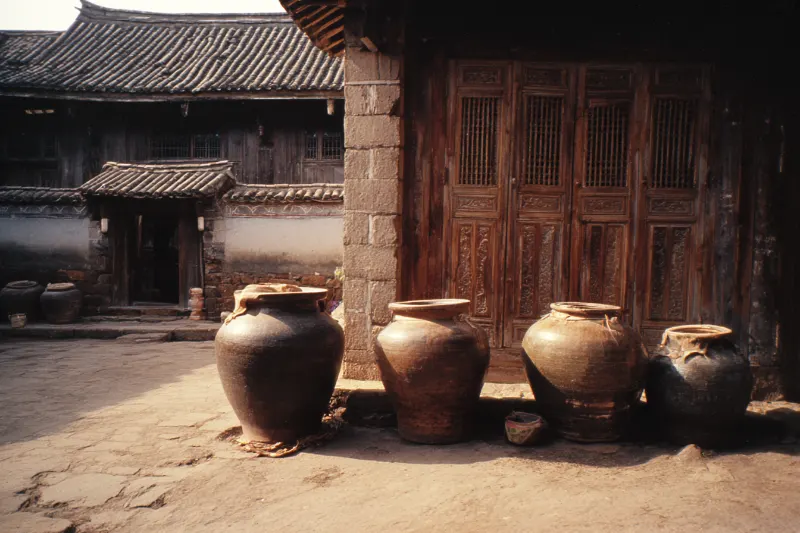
Somewhere in Lijiang, in Yunnan province, a clay jar may lie in the ground, sealed for years. Inside is wine made from roasted barley and wheat. Tradition says that if you leave it long enough, it stops being a liquid at all and gathers into a small, clear jelly that has to be loosened with water before anyone can drink it.
What 窨 means
The wine belongs to the Naxi people of Lijiang 丽江 (Lìjiāng), and its name is its method. 窨酒 (yìnjiǔ) uses a character, 窨 (yìn), that means to bury, or to put in a cellar. It is, quite literally, cellared wine, though here the cellar is the earth itself.
Few drinks in China announce their method so plainly. Where many names describe a place, a grain or a colour, this one describes patience.
Roasted grain, old wine, clay
The base is barley and wheat, not rice. According to a report on Lijiang's heritage, the grain is roasted and steamed several times, then mixed with old wine and sealed in pottery jars to ferment underground.
Two details deserve a sommelier's attention. The first is the roasting. Repeated roasting and steaming of grain before fermentation suggests a wine built on toasted, cereal flavours rather than on fresh fruit. The second is the old wine. Mixing a new batch with wine from a previous one gives each jar a link to the jar before it, an idea European readers may recognise from the way a solera blends older wine into younger.
The result, the same source says, is malty, sweet and mellow. It is often compared to 女儿红 (nǚ'érhóng), the famous aged Shaoxing rice wine whose name recalls an old custom of brewing wine at a daughter's birth and serving it at her wedding. Both are wines of keeping, and both carry the idea that time in a sealed jar is an ingredient.
The wine jelly
The most striking detail comes from 《名酒志》 (Míngjiǔ Zhì), a Chinese record of famous wines. It says that mash cellared for decades condenses into a small, clear "wine jelly", which is diluted with water before drinking.
Kept for decades, the account says, the wine condenses into a small, clear jelly.
We have no laboratory study of this, and no tasting note, so it is best read as the record presents it: a description of what very old 窨酒 becomes, passed down in writing. Still, for anyone who has opened an old bottle of sweet wine and found it thick, concentrated and changed, the image is not entirely foreign. It is the far end of the same road, taken further than any European cellar usually goes.
Heritage, and the jars today
The craft has official recognition. 窨酒制作技艺 (yìnjiǔ zhìzuò jìyì), the technique of making yinjiu, was placed on the third Yunnan provincial list of intangible cultural heritage in 2013. Our sources do not mention a national listing.
It is not only a museum memory. A Lijiang producer, 义和酒厂 (Yìhé Jiǔchǎng), appears in published photographs, and the wine is served at festivals and family gatherings. It is made locally, and we know of no exports. No source we have read gives its strength, so we will not guess one.
What makes 窨酒 worth knowing is the way it joins other Chinese traditions of buried wine. The Shui of Guizhou age their rice wine underground in clay jars. Shaoxing's 女儿红 carries the memory of jars kept for a daughter's wedding. China's oldest wines were also sealed: archaeologists have found liquid still inside Shang-dynasty bronzes whose lids had corroded shut. Across three thousand years, the same instinct returns: close the vessel and let time do the work.
Yinjiu belongs to the broad family of Chinese grain and rice wines, the fermented drinks that came long before baijiu. In that family it holds a quiet place of its own: a mountain wine of barley and wheat, buried in the earth and left to grow old.
How it's made
- Roast and steam barley and wheat several times.
- Mix with old wine.
- Seal in clay jars and bury them underground.
- Age for years; very old wine is diluted with water before serving.
How it's drunk
At festivals and family gatherings.
Its European cousin
Like a sweet wine laid down for decades, buried like Georgian qvevri.