雄黄酒
xiónghuáng jiǔ
The arsenic wine of the Dragon Boat Festival
3 min read
In 10 seconds
For centuries, Chinese families drank wine with an arsenic mineral at the Dragon Boat Festival, to keep evil away.
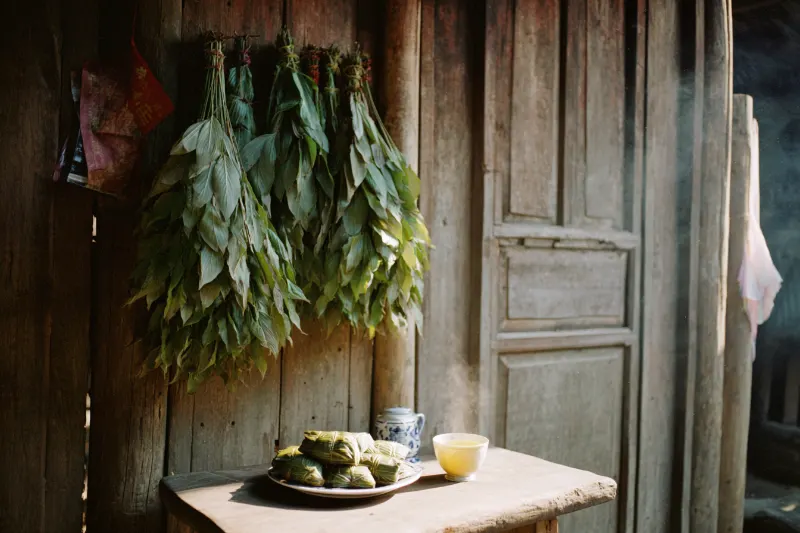
Picture the Dragon Boat Festival in an old Chinese household. The boats are out on the water, the family is gathered, and on the table stands a cup of wine with a mineral stirred into it. The adults drink a little. Then a finger goes into the cup and paints a mark on a child's forehead. For centuries this was protection. Today we know it was poison.
A festival cup against evil
The wine is 雄黄酒 (xiónghuáng jiǔ), realgar wine, and its day was the Dragon Boat Festival, 端午 (Duānwǔ), on the fifth day of the fifth lunar month. Families drank a cup to ward off evil and poisonous creatures, and what was left was painted on children's foreheads and limbs.
Realgar is not a herb or a spice. It is a mineral of arsenic. That single fact turns a charming folk custom into one of the most important warnings on this site.
What the laboratory found
In 2011 a team led by Zhang, with Sun, Huang, Williams and Zhu, published a study in *Environment International* on realgar wine and the people exposed to it. They measured 70 mg/L of arsenic in the wine, and all of it was inorganic arsenic.
Then they followed the people. In adults who had drunk the wine, arsenic in the urine peaked at about 550 µg/L, roughly 16 hours later. In children who had not drunk anything, but had only been painted with realgar on the forehead and limbs, it peaked at about 100 µg/L, around 40 hours after application. The authors described the custom as a "potentially serious and currently unquantified health risk".
Even the painted mark on a child's skin raised arsenic levels.
That second result matters most. It is tempting to think that the "external" version of the custom is harmless. The data say otherwise. A medical case series from Guilin on acute arsenic poisoning from "realgar water" points in the same direction.
How the custom is changing
China's own state media now say it plainly. A 2025 CGTN feature on the Dragon Boat Festival acknowledges that realgar "contains toxic arsenic compounds that can cause severe poisoning", and describes how drinking has largely given way to symbolic gestures, such as dabbing diluted wine on a child's forehead in the shape of the character 王.
This is how many food traditions survive: the meaning stays while the practice shrinks. But the 2011 data are a reason to go one step further. Even diluted, even only on the skin, realgar is not a safe gesture. The festival still has its boats and its family gatherings; the realgar cup belongs to history.
A warning, not a recipe
For this reason there is no method here, no list of ingredients, no proportions. That is a deliberate editorial choice. Realgar wine contains inorganic arsenic. It must not be made, drunk or painted on the skin of anyone, adults or children. If realgar wine is ever offered, at a festival or anywhere else, the right answer is no.
For a sommelier, the story has an uncomfortable familiarity. Europe has its own history of "protective" substances that were trusted for generations and later recognised as toxic, with mercury or lead. Tradition is not proof of safety, and a good wine culture is one that knows when to let a custom go.
What remains worth telling is the human side: families who believed, sincerely, that a cup and a painted mark would keep evil and poisonous creatures away from their children. Understood that way, 雄黄酒 is less a drink than a fear given a colour.
The cup that should be on the festival table today is something else entirely. Chinese rice wine, brewed from grain and shared at the table, is one of the oldest and gentlest roads through Chinese drinking culture, and a far better companion for any festival.
How it's made
- A festival custom, not a recipe.
- Families drank a cup at the Dragon Boat Festival.
- The rest was painted on children's foreheads and limbs.
- Today the custom is mostly symbolic.
How it's drunk
At the Dragon Boat Festival, the 5th day of the 5th lunar month.
Its European cousin
Like Europe's old 'protective' remedies with mercury or lead: once trusted, now known to be toxic.
Contains inorganic arsenic. Never drink it or apply it to the skin, including on children.