酒海
jiǔhǎi
The 'wine seas' of wicker and paper
3 min read
In 10 seconds
Giant baskets woven from mountain branches, lined with paper, sealed with egg white and beeswax. They hold baijiu for years, and they breathe.
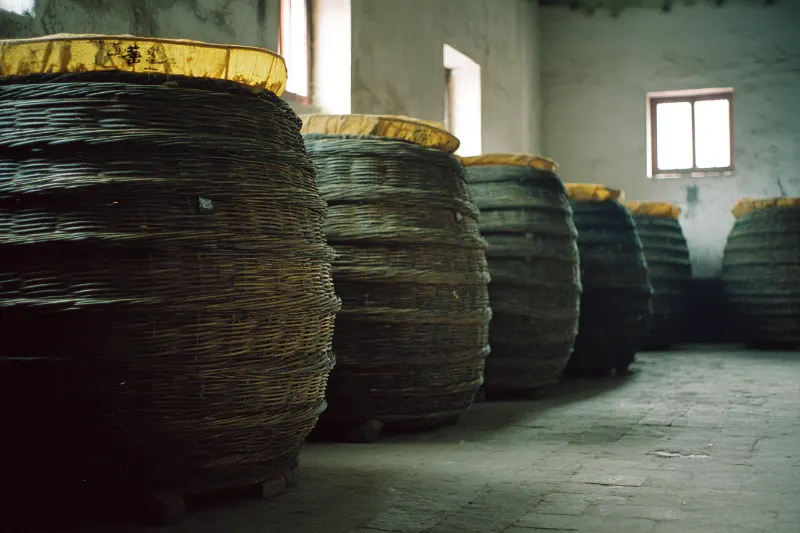
Picture a huge basket, woven from mountain branches and lined on the inside with paper. Now picture it full of spirit. In Fengxiang, in Shaanxi province, this is not a curiosity in a museum. It is where Xifeng baijiu spends at least three years of its life, in vessels the Chinese call 酒海 (jiǔhǎi): "wine seas".
Thorn wood, hemp paper, egg white
Xifeng 西凤 (Xīfèng) is a baijiu from Fengxiang 凤翔 (Fèngxiáng), a district of Baoji. Its brewing technique was added to China's national list of intangible cultural heritage in 2021. The official listing sets one rule that defines the style: new spirit must be stored for more than three years in 酒海 made of hemp paper and a "biological adhesive".
A 2021 report by Xinhua's economic information service describes what that means in practice. Branches of 荆条 (jīngtiáo), a thorny shrub from the Qinling mountains, are woven into huge cages. The inside walls are pasted with hemp paper, 麻纸 (mázhǐ). A coating of egg white, beeswax and cooked rapeseed oil, mixed in set proportions, is rubbed on and left to dry. Another report speaks of willow-woven vessels. Either way, the result is something between basketry, bookbinding and cellar craft.
A vessel that breathes
A wine lover's first question is obvious: what does the container do to the spirit? The Xinhua report says the 酒海 "breathes". A 2022 study in the Chinese journal 《食品科学》 tested it. Baijiu stored in a 酒海 was compared with baijiu stored in ceramic jars and in stainless steel. The 酒海 spirit had more esters, aldehydes and ketones, the lowest total acidity and the highest soluble solids.
For a sommelier this is the language of oak, transposed. Wood is not the material here, but the principle is similar: a porous, living vessel that lets the spirit change slowly, rather than an inert tank that only holds it. People's Daily has called these vessels 活文物 (huó wénwù), "living cultural relics".
The rest of the Xifeng process is worth a glance, too. The starter is made from barley and peas, shaped in wooden moulds and grown for about thirty days. Production runs from September to June, with sorghum fermented in earthen cellars and distilled several times. Distillers cut away the heads and tails and keep the heart, judging partly by eye, by watching the 酒花 (jiǔhuā), the bubbles that form on the running spirit. The official listing describes the resulting aroma as led by ethyl acetate, with ethyl caproate in a supporting role. Together, storage and fermentation define the house style known as 凤香 (fèngxiāng), "Feng aroma".
海量, "an ocean's capacity", is what Chinese call a heroic drinker, and the phrase is said to come from these vessels.
The pig blood question
Read about 酒海 online and you will soon meet pig blood. It is a real detail, but it belongs somewhere else. The sources on Xifeng speak of egg white, beeswax and rapeseed oil, and none of them mentions blood.
Pig blood is documented for the wider 酒海 tradition of northern China. In 2026 the 内蒙古日报 (Inner Mongolia Daily) described willow-woven 酒海 used in Shanxi, Inner Mongolia and northern Hebei since the Ming and Qing dynasties, sealed with an old formula of 猪血 70%、生石灰 20%、蛋清 10%: pig blood, quicklime and egg white. The baijiu writer Derek Sandhaus has described willow containers at a distillery in Baoding, Hebei, sealed with cotton paper, pig's blood and egg whites. So the story is true, just not for Xifeng.
The 酒海 shows a side of baijiu that rarely reaches European glasses: the patience of storage. The world of Chinese spirits is usually explained through grain and fermentation, but in Fengxiang the vessel has its own voice, and a woven basket of paper and egg white is as much a part of the flavour as the sorghum itself.
How it's made
- Weave a large cage from 荆条 branches.
- Line the inside with many layers of hemp paper (麻纸).
- Seal the paper with egg white, beeswax and cooked rapeseed oil.
- Fill with new baijiu and age it for at least 3 years.
How it's drunk
The aged spirit is bottled as Xifeng, one of China's historic 'famous liquors'.
Its European cousin
Like a solera: a vessel that slowly shapes the spirit over years.
Pig blood linings are documented for some old 酒海 in northern China, not for Xifeng.