蒸馏之谜
zhēngliú zhī mí
When did China start distilling?
3 min read
In 10 seconds
A bronze still in a Han emperor's tomb. A 3,000-year-old owl-shaped vessel. Was baijiu born much earlier than we think?
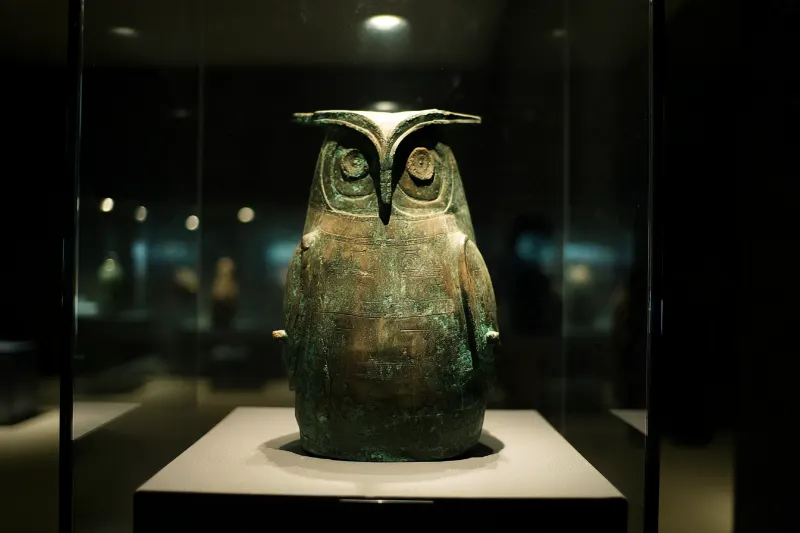
A deposed emperor buried with a bronze still. A bronze vessel in the shape of an owl, its lid fused shut for 3,000 years, with liquid still sloshing inside. A Ming-dynasty physician who wrote, flatly, that strong liquor was a recent invention. These are the three witnesses in one of the liveliest debates in Chinese drinks history: when did China start distilling?
The classic answer: the Yuan
For centuries, the standard answer came from 李时珍 (Lǐ Shízhēn), the great Ming physician, and his 《本草纲目》 (Běncǎo Gāngmù), the Compendium of Materia Medica, completed in the late sixteenth century. In its entry on 烧酒 (shāojiǔ), "burnt liquor", he wrote: "烧酒非古法也,自元时始创其法". In English: burnt liquor is not an ancient method; its technique was first created in the Yuan dynasty. He described it as "clear as water, extremely strong in taste", and called it the "dew of wine".
Commentators link this to 哈剌吉 (hālàjí), the arak brought into Yuan China from the Western Regions. On this view, Chinese distilling arrived with the Mongol empire, in the thirteenth and fourteenth centuries, not so different in time from the spread of distilled spirits in medieval Europe.
A still in a Han tomb
Archaeology has complicated the picture. In the tomb of 刘贺 (Liú Hè), the deposed Western Han emperor who later became the Marquis of Haihun, 海昏侯 (Hǎihūn Hóu), in Nanchang, Jiangxi, excavators found a bronze distilling apparatus.
A team led by the head of the excavation built a half-scale replica in three parts. It distilled yellow wine and beer, with a reported 70 percent distillation efficiency, and the team also made distilled liquor from taro using a process believed to date from the period. Popular Science noted that this could push the earliest evidence back by as much as 1,000 years.
But being able to distil alcohol is not the same as having been used for it. Some experts have argued the apparatus served alchemy or medicine: refining cinnabar and mercury, or making "flower dews". One collaborator says residue analysis rules out the flower-dew theory. Xinhua, reporting in 2025, put it carefully: distilling apparatus is known from the Haihunhou tomb and from a Xin-dynasty tomb at Zhangjiabu 张家堡 (Zhāngjiābǔ) in Xi'an, so the technology existed by the Han, but "it was not certain whether it was used to make liquor".
Being able to distil alcohol is not the same as having been used for it.
An owl full of questions
In January 2025 came the boldest claim. In 2010, archaeologists at Daxinzhuang 大辛庄 (Dàxīnzhuāng), in Jinan, Shandong, had excavated a late-Shang bronze owl-shaped vessel, a 铜鸮卣 (tóng xiāo yǒu), from tomb M257, with its lid fused shut. When a Shandong University team opened and tested the liquid, they reported ethanol, ethyl acetate and water, but no sugars or proteins. Their conclusion: the liquid had been distilled, pushing Chinese distillation back about 3,000 years. The same lab says liquid from Han tombs at Sanlibu, in Yantai, was also distilled.
This claim must be read with caution. It is contested, it comes from a single lab, and it was reported through state media; no peer-reviewed paper was found. The reasoning also rests on one line of argument. Sugars and proteins can break down over three millennia, and ethanol and ethyl acetate can come from an ordinary fermented drink. "No sugar" does not have to mean "distilled".
What can be said safely
Put the three witnesses side by side and a cautious picture emerges. Stills existed in China at least 2,000 years ago. Whether people used them to make spirits for drinking is still argued over. And baijiu as a widespread drink is probably no older than the Yuan and Ming dynasties.
For a European reader, this is oddly familiar territory. In Europe too, the story of early distilling is entangled with medicine and alchemy. What is unusual about China is how much physical evidence survives, and how fiercely it is still being read.
Whatever the answer turns out to be, distillation was a late chapter. Long before the first drop ran from a still, China had thousands of years of fermented drinks behind it, from rice and honey at Jiahu to herbal wines sealed in Shang bronzes. Baijiu is the newest branch of a very old tree.
How it's made
- Yuan dynasty: the classic view from Li Shizhen.
- Han dynasty: the Haihunhou bronze still.
- Shang dynasty: the 2025 owl-vessel claim, contested.
How it's drunk
History.
Its European cousin
In Europe, distilled spirits appear in the Middle Ages. China's story may be far older, or not.