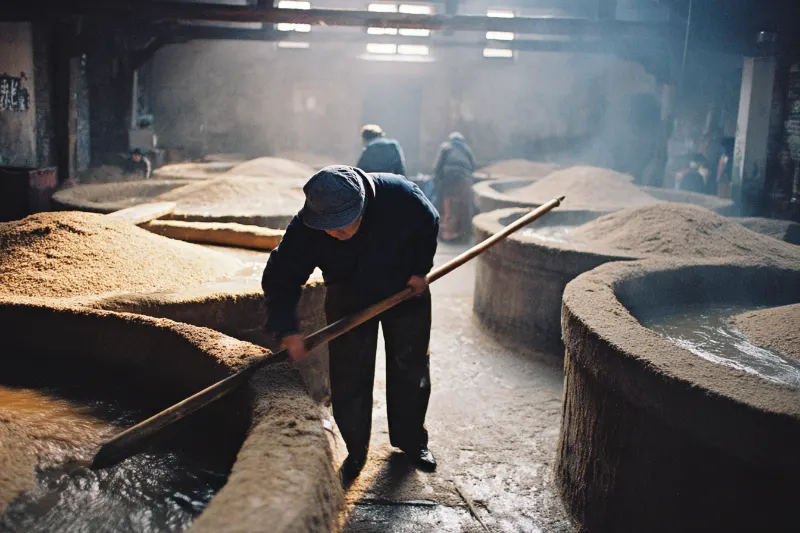
冬酿 · 开耙
dōngniàng · kāipá
Winter brewing and the masters of the rake
3 min read
In 10 seconds
In Shaoxing, wine is brewed only in winter. Masters called 'the brains' decide when to rake the mash.
When the cold arrives in Shaoxing, the breweries wake up. Glutinous rice is soaked and steamed, water is drawn from Jianhu Lake, and in rows of earthenware vats a mash begins to bubble. For the next few months, the most important person in the room is not the owner or the chemist but an old master with a rake, deciding, by touch and smell, when to plunge it in.
A calendar written in seasons
Shaoxing yellow wine, 黄酒 (huángjiǔ), is a rice wine, brewed and aged rather than distilled. Its brewing technique has been national intangible heritage since the first batch, in 2006.
What makes it special is that it still follows a farming year. In summer, around the seventh lunar month, brewers make 酒药 (jiǔyào), a starter made as small rice balls. In the ninth lunar month they make wheat qu, 麦曲 (màiqū). Brewing proper begins in winter, 冬酿 (dōngniàng). Xinhua's 2025 report sets the start at 立冬 (Lìdōng), the "Start of Winter" in the traditional solar calendar, which fell on 7 November that year. The heritage record itself describes the brewing season running from around 大雪 (Dàxuě), "Major Snow", in early December. Either way, this is a winter wine.
The rest of the year is marked by solar terms too. The wine is pressed at 立春 (Lìchūn), the Start of Spring in early February, and the jars are sealed at 谷雨 (Gǔyǔ), Grain Rain, in late April.
Why winter? A 2016 report in 文汇报 (Wenhui Daily) gives the brewers' reason: the cold helps hold back unwanted microbes. Xinhua adds that the lake water is said to be at its purest after Lidong. "The 90 days after Lidong are the key period for brewing yellow wine," says 吴兴刚 (Wú Xīnggāng), quoted by Xinhua.
Blood, flesh and bone
Shaoxing brewers describe their wine almost as a body. The water of Jianhu Lake, 鉴湖 (Jiànhú), is called its "blood". Glutinous rice and wheat qu are its "flesh and bone".
The heritage record lists the steps: sieve and soak the rice, steam it, spread it to cool, then combine it with wheat qu, a rice "mother" and lake water. Main fermentation follows, then a second fermentation in jars, pressing, clarifying, blending and a heating step, 煎酒 (jiānjiǔ), to stabilise the wine before it goes into jars to age for three years or more. The tools named are humble ones: earthenware vats, wine jars and straw lids for the vats.
The masters of the rake
In the middle of that list sits one short word: 开耙 (kāipá), "opening the rake". During main fermentation the mash is raked to regulate its temperature and to let in fresh air. According to Wenhui Daily, it happens three or four times a day for every vat in the early fermentation, and it is "the key step in hand brewing". How well it is done decides the quality of the finished wine.
In Shaoxing, the people who decide when to rake the mash are called, simply, "the brains".
The job is overseen by experienced old masters, known as 头脑 (tóunǎo), "the brains". Xinhua describes them judging the mash by touch and smell alone.
For a European winemaker, the closest gesture is pigeage, punching down the cap of skins on a fermenting red wine several times a day. The aim is similar: to manage heat and air, and to keep the fermentation healthy. The difference is the mash itself, which is rice, qu and water, and the knowledge, which lives in the hands of a few senior brewers.
Shaoxing producers are traditionally divided into two schools, 东帮 (dōngbāng) and 西帮 (xībāng), "East" and "West", according to where their workshops are and how they work. Both work to the same winter calendar and the same lake water.
Aged Shaoxing is usually drunk warm, with food, and it is widely exported. Behind the familiar bottle, though, sits a whole world of rice wines, from red-qu wines of Fujian to sweet sealed-jar wines of Jiangsu: the other great road of Chinese drinking, running alongside baijiu.
How it's made
- Start brewing at 立冬, early November.
- Rake the mash (开耙) three to four times a day in the first fermentation.
- Press the wine at 立春, early February.
- Seal the jars at 谷雨, in April.
How it's drunk
Aged Shaoxing is drunk warm with food.
Its European cousin
Like punching down the cap in red winemaking, several times a day.