三口一杯
sān kǒu yì bēi
Three sips, one cup, a finger to the sky
3 min read
In 10 seconds
Before drinking, the guest dips the ring finger in the wine and flicks it to the sky three times: for heaven, earth and the gods.
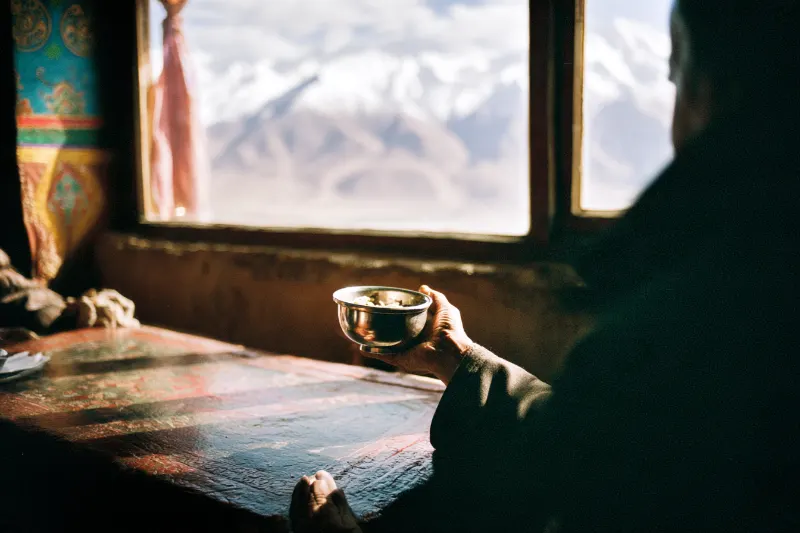
The cup arrives full. Sometimes it is a silver bowl, heavy in the hand, holding half a jin or more, around 250 grams of barley wine. Nobody drinks yet. The guest lowers the ring finger into the wine, lifts it, and flicks a few drops upward. Once, twice, three times. Only then does the cup reach the lips.
A toast that begins with the sky
The gesture has a name: 三口一杯 (sān kǒu yì bēi), "three sips, one cup". A 2015 report by 人民政协网 describes it as the most important toasting etiquette when Tibetan hosts receive guests. The three flicks are made "以示敬天敬地祭众神": to honour heaven, to honour earth, and to make an offering to the gods.
For a European reader the image is instantly familiar. It is the old Mediterranean libation, the first drops given away before the drinker takes anything for himself. What changes is the finger. Not the thumb, not the index, but the ring finger, a detail the source is careful to record.
Three sips, one cup
Then comes the arithmetic of hospitality. The guest takes a single sip, and the host refills the cup. Another sip, another refill. On the third round the guest finally drains it. Only after that is the guest free to drink at will, or to stop.
The effect is quietly generous. For three rounds the cup never stays low for long; the host makes sure of that. The same source notes a parallel rule for butter tea, where the host keeps topping up the bowl and a guest who is leaving should not empty it. In both cases the full vessel is the message.
The first drops go to heaven, earth and the gods; only then does the guest drink.
There is humour in it, too. According to the same report, some hosts playfully flip the ritual for visitors, turning "three sips, one cup" into "three cups, one sip". A courteous ceremony becomes a friendly test of stamina, and an outsider learns quickly who is in charge of the evening.
In Huzhu, Qinghai, the Tu people have a close cousin of the gesture. At Tu weddings, according to 中国作家网, guests offered the three cups of welcome may "弹指三下,或者一饮而尽": flick three times with the finger, or drain the cup.
What is in the bowl
The drink is usually 青稞酒 (qīngkē jiǔ), the fermented highland-barley drink known in Tibetan as chang. Here honesty matters more than poetry. Our research could not verify, from Chinese sources, how this home-made chang is brewed or how strong it is, so we will not offer a method, an ABV or tasting notes. What we can say is that it is a grain drink of the high plateau, and that the ritual is about the act of offering more than about the liquid.
Some, but not all
One more caveat belongs at the centre of this story, not in a footnote. A 2024 ethnographic study in the journal *HIMALAYA*, by Brown, Thakuri and Childs, describes households in Himalayan Tibetan communities that keep their own still, where fermented and distilled drinks run through rituals, gatherings and the exchange of labour between families. The fieldwork was in Nubri, Nepal, not in China. And the authors stress that alcohol matters in "some, but certainly not all, Tibetan societies"; in some contexts drinking is contested.
So 三口一杯 is not a portrait of every Tibetan table. It is a custom of welcome where alcohol is part of welcome, recorded with care, and best read that way. Butter tea, with its own rule of the never-emptied bowl, is the other half of the same welcome.
What travels well is the grammar of the gesture: pause, give away the first drops, then drink. It is a grammar of respect that turns up, in many registers, wherever Chinese drinks are poured. And the barley itself has another life in Qinghai, where distilled 青稞酒 is listed as a national heritage craft: a reminder that the high plateau is one of the many roads into the vast and varied world of Chinese baijiu.
How it's made
- The host offers a cup of barley wine.
- The guest dips the ring finger and flicks drops upward three times.
- The guest sips, and the host refills; this is repeated.
- On the third round the guest empties the cup.
How it's drunk
When welcoming guests, often with a silver bowl.
Its European cousin
Like the libation of ancient Greece: the first drops go to the gods.
Alcohol matters in some Tibetan communities, but certainly not all.