红标米酒
hóngbiāo mǐjiǔ
The cooking wine that emptied the shelves
3 min read
In 10 seconds
When a tax raised the price of Taiwan's cooking rice wine from NT$21 to NT$130, families hoarded up to 228 million bottles.
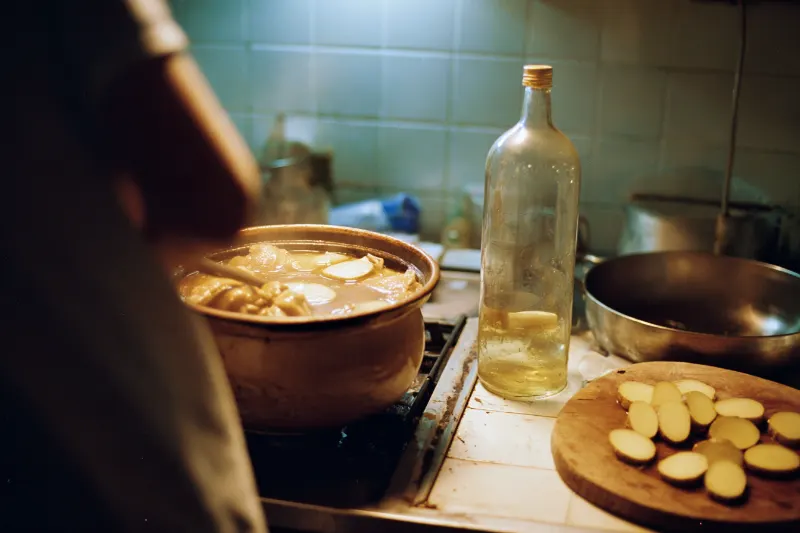
In many Taiwanese kitchens it stands near the stove: a bottle with a red label. It is not really for the table. It goes into the pot, into stews and stir-fries, over chicken and duck with sesame oil and ginger. It was the most ordinary bottle in the house, until a trade agreement turned this humble cooking wine into a national story.
The bottle by the stove
The drink is 红标米酒 (hóngbiāo mǐjiǔ), written in Taiwan as 紅標米酒: Red Label rice wine. According to the Taiwanese health site EDH 早安健康, the cooking version, 紅標料理米酒, is 19.5% ABV. It is distilled and then blended with refined edible alcohol. A pure-rice version, 純米 (chúnmǐ), is also bottled at 19.5%.
Its natural home is the stew pot and the wok. EDH names two dishes above all: 麻油雞 (máyóu jī), sesame-oil chicken, and 薑母鴨 (jiāngmǔ yā), ginger duck. For a European reader, the closest parallel might be the cooking Marsala of Italian kitchens: a bottle that belongs to the pantry, not the cellar, and that quietly defines the flavour of a whole family of dishes.
Seasoning or spirit?
Then came the question no cook had ever asked: is rice wine a seasoning or an alcoholic drink?
When Taiwan joined the World Trade Organization, according to a 2002 report in the Taipei Times, trading partners required that rice wine be taxed as an alcoholic beverage rather than as a cooking condiment. The consequence was a tax of NT$90 per bottle. A 0.6-litre bottle that had cost NT$21 would now cost NT$130.
A bottle that cost NT$21 was about to cost NT$130.
For a staple of ordinary home cooking, the jump was enormous. And people reacted exactly as people do.
228 million bottles
They stockpiled. Consumers and retailers, the Taipei Times reported, hoarded up to 228 million plastic PET bottles of rice wine. To put that in perspective, the same report gives national demand at about 204 million bottles a year. In other words, at its peak the hoard could have covered more than a full year of the island's consumption.
The maker was TTL, formerly the Taiwan Tobacco and Wine Board. And there was a twist that every sommelier will appreciate: the stock had a deadline. According to the Taipei Times, the PET-bottled stock expired on 24 December 2002. A hoard built to beat a tax came with a deadline of its own.
It is easy to smile at the image of homes and shops stacked with red labels. But the story says something serious about food culture. A cooking wine can be as essential as salt. When its price suddenly multiplies, people do not simply switch; they protect the taste of home.
Why the story matters
For European readers, the Red Label saga is a lesson in how categories shape culture. In Europe, too, the line between food and drink can be blurry: cooking wines, fortified wines, liqueurs used in pastry. Where that line is drawn decides taxes, prices and, sometimes, the fate of a recipe.
It also explains why Red Label rice wine remains an icon. Behind the plain red label lies a moment when an entire island made clear how much a bottle of cooking wine mattered.
Bottles of Taiwanese rice wine can be found in some Asian shops abroad, though EU availability has not been verified. Taste it in a sesame-oil chicken rather than in a glass, and it opens a door onto a wider world: the many roads of Chinese rice wine, from the kitchen to the banquet table.
How it's made
- Distil a rice spirit.
- Blend with refined food-grade alcohol.
- Bottle at 19.5%.
How it's drunk
Mostly in the kitchen, in tonic dishes and winter soups.
Its European cousin
Like cooking Marsala in Italian kitchens, until a tax turned it into a national story.