青稞酒
qīngkē jiǔ
Highland barley spirit and the Tu wedding toasts
3 min read
In 10 seconds
Fermented in pits of Kunlun granite and pine, and toasted with three cups 'to mount the horse'.
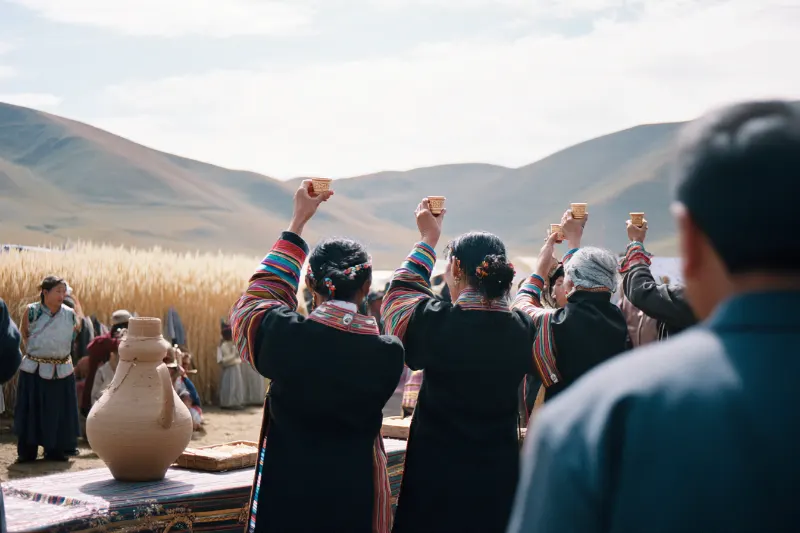
At about 2,600 metres in Qinghai, on the edge of the Tibetan plateau, a wedding party gathers its horses. Before anyone rides off to fetch the bride, cups are filled. Three of them. This is 上马酒 (shàngmǎ jiǔ), "mounting-horse wine", and the drink inside is the spirit of the high plateau: 青稞酒 (qīngkē jiǔ), distilled from highland barley.
Granite, pine and eighty days
Huzhu, 互助 (Hùzhù), is China's only Tu autonomous county and home to the largest concentration of the Tu people. Its barley spirit craft entered the national intangible heritage list in 2021 as part of the distilled-spirit category. The method recorded there is unlike anything in a Scottish distillery.
Each fermentation round lasts about 80 days. The grain is loaded once and then goes through four fermentations and four distillations. The pits where it ferments have walls of Kunlun granite and floors of pine boards. And qingke has a distinction: it is the only grain in Chinese baijiu that is also used to make its own qu starter. Brewing, the record says, runs 365 days a year.
The traditional slogan is "清蒸清烧四次清" (qīngzhēng qīngshāo sì cì qīng), a reminder of how clean and repeated the steaming and distilling are meant to be. The spirit is classed as light-aroma, 清香型 (qīngxiāng xíng). Base spirit is aged in pottery jars, in 酒海 (jiǔhǎi), the large lined storage vessels of northern China, or in steel, and the company has even tested oak barrels for a "qingke whisky".
Three cups to ride, three cups to arrive
The drink matters most at the table. A 2022 account in 中国作家网 (Zhōngguó Zuòjiā Wǎng) describes the Tu wedding: three cups of 上马酒 before the bride-fetching party leaves, and three cups of 下马酒 (xiàmǎ jiǔ), "dismounting wine", when it arrives, described as an indispensable Tu courtesy. Guests may flick the drink three times with a finger, or simply drain the cup.
At a Tu wedding, a wrong answer in a song costs a drink.
The same account records penalty drinks. A groom who forgets a gift drinks three cups. In call-and-response singing, 对歌 (duìgē), a wrong answer costs a cup too. A proverb sums it up: "无酒不成席" (wú jiǔ bù chéng xí), no wine, no banquet. Locals add, with a grin, that "even Huzhu's sparrows can drink two liang".
Heritage craft, industrial brand
Here honesty matters. Huzhu qingke spirit is not a village secret. In 1952 eight workshops were merged on the site of the old 天佑德 (Tiānyòudé) workshop into a state factory, and today the heritage listing's protection unit is the listed Huzhu qingke company itself. Xinhua reports that the drink is a national geographical-indication product, used by 20 authorised enterprises, with medals in Brussels and Hong Kong, and that a visitor complex billed as "the source of qingke liquor" received more than 70,000 visitors in 2024.
So this is an industrial, heavily packaged spirit built on a genuine heritage craft. The older home method survives under the name 土法酩馏 (tǔfǎ mǐngliù), the folk distillation the heritage item names as its foundation. At a small workshop called 匠心酿 (Jiàngxīn Niàng), black qingke is still distilled this way, in front of visitors.
The sources consulted do not give an alcohol strength for the bottled spirit, so none is given here.
Barley, two ways
For a European reader the barley is the obvious bridge. Scotch starts from barley too, but there the grain becomes a liquid wash before distillation. In Huzhu it ferments as solid grain in stone pits, which is the logic of Chinese baijiu, not of whisky.
The heritage page calls qingke spirit a daily necessity for Tibetan people and a link between the peoples of the plateau. That deserves a nuance: alcohol matters in some, but not all, plateau communities, and drinking is not universal there.
Huzhu's barley spirit is one high, cold branch of baijiu, the great family of Chinese grain spirits. Follow that family down from the plateau and you meet sorghum, wheat and rice, each with its own pits, stills and toasts.
How it's made
- Make the starter from highland barley.
- Steam qingke and ferment it in granite-walled pits.
- Ferment and distil four times over about 80 days.
- Age and bottle.
How it's drunk
At weddings and festivals; singing contests end with penalty drinks for the loser.
Its European cousin
Like Scotch, it starts from barley, but it ferments as solid grain in stone pits.