女儿红
nǚ'érhóng
The wine kept for a daughter's wedding
3 min read
In 10 seconds
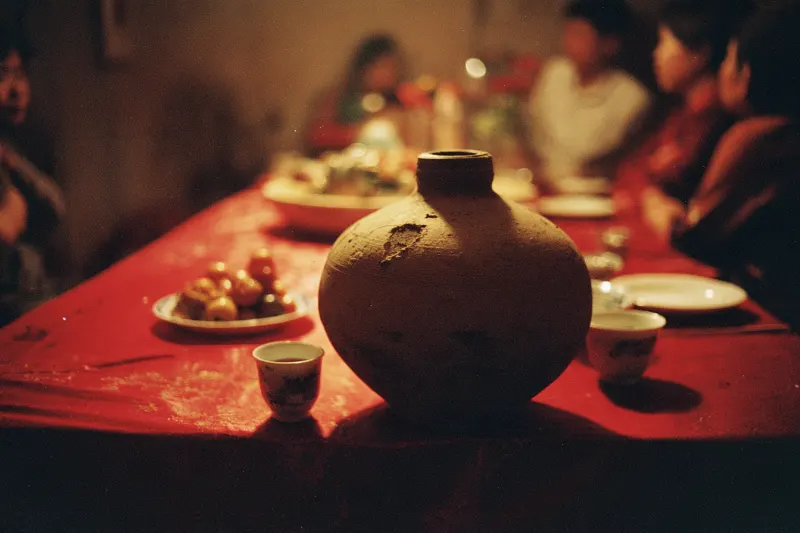
When a daughter was born, the family brewed jars of wine. They were opened on her wedding day.
A daughter is born in a house in Shaoxing. Somewhere in the courtyard, jars of wine are sealed and set aside. Years pass. She grows up, she marries, and on the day of her wedding the jars are opened and poured for the guests. That is the story behind one of the most beautiful names in Chinese wine.
A custom, a dictionary, a brand
The name is 女儿红 (nǚ'érhóng), "daughter red". The Chinese dictionary zdic.net defines it with care: "一种陈年绍兴酒。旧时风俗,凡生下女儿,则酿酒数瓮,待女儿出嫁时,取出宴客。" An aged Shaoxing wine; by an old custom, when a daughter was born several jars were brewed, then brought out to serve guests at her wedding.
The key word is 旧时, "in former times". The custom is real, but it belongs mostly to the past. Today 女儿红 is above all a commercial name for aged Shaoxing wine, such as the Pagoda brand 塔牌女儿红 (Tǎpái nǚ'érhóng) sold abroad in 750 ml bottles. What is inside is decided by the age on the label, not by anyone's daughter.
The dictionary adds a charming footnote: in Yangzhou, 女儿红 is also the name of a small red radish.
The idea is not unique to Shaoxing, either. Among the Shui people of Sandu, in Guizhou, CGTN reports that parents buried wine at a daughter's birth and served it at her wedding. Different region, different wine, the same instinct: to set something aside for a future celebration.
The lake, the winter and the brains
Behind the romance stands one of China's best documented crafts. Shaoxing yellow-wine brewing, 绍兴黄酒酿制技艺 (Shàoxīng huángjiǔ niàngzhì jìyì), has been on the national intangible heritage list since the very first batch in 2006. According to the heritage listing, the craft dates back to the Spring and Autumn period, took shape in the Northern Song and flourished under the Ming and Qing, with producers divided into an "East" and a "West" school.
Its essential ingredient is water from 鉴湖 (Jiànhú), Jian Lake. A 2025 Xinhua report records the local saying that the lake water is the "blood" of the wine, while glutinous rice and wheat qu are its flesh and bone, and that the water is said to be purest after 立冬 (Lìdōng), the start of winter in early November.
The lake is the blood of the wine; rice and wheat are its flesh and bone.
The year follows the farming calendar. The rice-ball starter, 酒药 (jiǔyào), is made in the seventh lunar month and the wheat qu in the ninth. Brewing happens in the cold, which, as the newspaper 文汇报 (Wénhuì Bào) notes, helps keep unwanted microbes in check. One brewer quoted by Xinhua calls the ninety days after 立冬 the key period. The wine is pressed around 立春 (Lìchūn), the start of spring, and the jars are sealed at 谷雨 (Gǔyǔ), Grain Rain, in late April.
The hand on the rake
The decisive gesture is 开耙 (kāipá), raking the fermenting mash. In primary fermentation each vat is raked three or four times a day, to regulate its temperature and let in fresh air. The job falls to experienced masters, known as 头脑 (tóunǎo), "the brains", who judge the mash by touch and smell alone. The quality of the finished wine, the 文汇报 says, depends on how well it is done.
After pressing comes clarifying, blending, heating to sterilise, and at least three years of ageing in jars. The heritage listing names the main Shaoxing types as 元红 (yuánhóng), 加饭 (jiāfàn), 善酿 (shànniàng) and 香雪 (xiāngxuě), a family of styles any sommelier would want to taste side by side.
For a European wine lover the emotional parallel is obvious: the case of a child's birth-year vintage, laid down in the cellar and opened at a milestone. The Shaoxing version simply did it with rice, winter and lake water.
Bottles called 女儿红 are widely sold in Asian shops abroad, and they are a natural first step into Chinese rice wine, the vast world from which this daughter's story was brewed.
How it's made
- Brew yellow wine in winter from glutinous rice, wheat qu and lake water.
- Seal the jars when a daughter is born.
- Store them for years.
- Open them for her wedding banquet.
How it's drunk
Traditionally at weddings. Today aged Shaoxing is drunk warm with food.
Its European cousin
Like laying down a case of a child's birth-year vintage.