奶酒
nǎijiǔ
The spirit distilled from milk
3 min read
In 10 seconds
Mongolian herders turn the whey left over from cheese-making into a spirit, so nothing goes to waste.
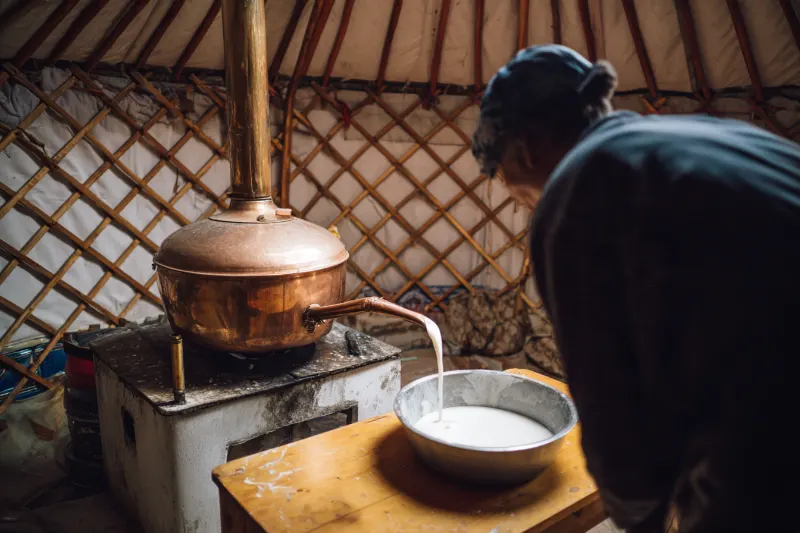
On the grasslands, milk is not just food. It is wealth, offering and season all at once, and herders have long known how to turn it into a dozen different things: yoghurt, curds, cheese. When all of that is done, a pale, thin liquid is left in the pail. In the Mongolian dairy tradition, even that has a destiny. It becomes 奶酒 (nǎijiǔ), a spirit distilled from what remains of the milk.
The craft of white food
The clearest record of this comes from China's national intangible heritage list. In 2014 the dairy craft of the Mongols was inscribed as 奶制品制作技艺(察干伊德), item Ⅷ-226, declared by Zhenglan Banner, 正蓝旗 (Zhènglán Qí), in Inner Mongolia. 察干伊德 (chágān yīdé) means "white food", the collective name for everything made from milk.
The heritage record describes milk from cows and sheep, processed by hand stirring and natural fermentation. It notes that whey left after separation is used to make milk liquor, so that none of the milk goes to waste. It also says white foods are used in offerings to ancestors and spirits, and it traces the craft back to the Yuan court's livestock office, the 畜群局 (xùqún jú).
A European reader will find the logic familiar. It is the same thrift that turned grape pomace into grappa and cider pressings into eau-de-vie: the leftovers of one craft become the raw material of another.
A herder's shop in Xinjiang
Mongolian communities also live in Xinjiang, far to the west, and there the tradition has its own regional heritage item: 新疆蒙古族奶酒酿造技艺, the Mongolian milk-liquor brewing craft of Xinjiang. According to a report by ifeng, its representative keeper is 布鲁盖 (Bùlǔgài), a herder in a village of 和静县 (Héjìng Xiàn), Hejing County, in Bayingolin.
The stages named in the report are simple: choosing the material, fermentation, distillation and storage. Her milk is cow's milk. And the drink does not stay behind closed doors. She sells it in her own dairy shop in Hejing, among the other milk foods of the region.
When the cheese is made, a pale liquid is left in the pail. Even that has a destiny.
This is the scale at which milk spirit lives: a household skill, a family recipe, a small shop. No source consulted for this guide gives an alcohol strength, and none mentions export.
Not to be confused with mare's milk
Europeans who have heard of steppe drinks usually think of fermented mare's milk, 马奶酒 (mǎnǎi jiǔ), the Mongolian airag or Kazakh qymyz. That is a different drink. China Daily describes it as about 1.5–3% ABV, a light fermented milk drunk in summer and served as a sign of respect at weddings and festivals.
Milk spirit takes a further step. The whey is fermented and then distilled, which concentrates the alcohol and changes the character entirely. The Mongolian name noted in the research is arkhi, rendered in Chinese as 阿日黑 (ārìhēi). Where mare's milk is the gentle drink of the summer pasture, milk spirit is the clear, stronger product of the still.
A drink for guests and ancestors
What links both drinks is their place in hospitality and ritual. White foods, in the words of the heritage record, are offered to ancestors and spirits. A bowl of something made from milk is a gesture of respect, to the living and to the dead.
For a sommelier, milk spirit poses an interesting question that the sources cannot yet answer: what does fermented whey become after distillation? No reliable tasting description exists in the research, and it would be wrong to invent one. What can be said is where it comes from, how it is made, and why: so that nothing the animals give is wasted.
Milk spirit belongs to the wider family of Chinese distilled drinks, most of which start from grain rather than milk. Set beside the sorghum stills of the south, it is a reminder that distillation in China has many raw materials, and that some of the most surprising ones come from the grasslands.
How it's made
- Make yoghurt, curds and cheese from the milk.
- Collect the leftover whey.
- Ferment it.
- Distil it into a clear milk spirit.
How it's drunk
Offered to guests and at celebrations; white foods are also offered to ancestors.
Its European cousin
Like grappa: made from what is left over, so nothing is wasted.