慕萨莱思
mùsàláisī (musallas)
The Silk Road wine made by boiling the must
3 min read
In 10 seconds
In Awati, grape juice is boiled down in a pot before it ferments, sometimes with saffron, rose and even pigeon blood.
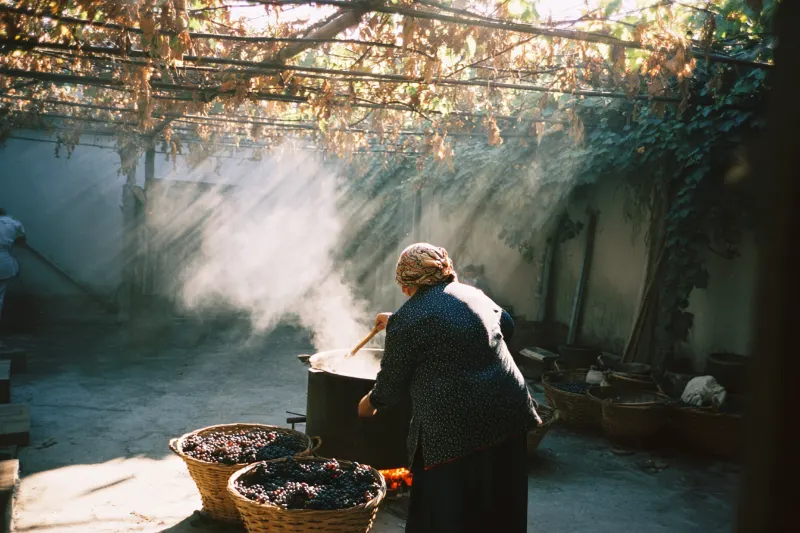
In Awati, a county in Xinjiang, in China's far west, grape juice goes into a pot before it goes into a jar. It is boiled down over the fire until it thickens, then scented with whatever the family has always used: saffron, rose, cloves, goji. Some households add stranger things. About forty days later there is a wine, hazy, brown and sweet, made at home and poured for guests.
A pot on the fire
The wine is 慕萨莱思 (mùsàláisī), also written 穆塞来斯, and known in English as musallas. It comes from Awati County, 阿瓦提县, in the Aksu region of Xinjiang, and it is a home tradition of some Uyghur families there.
A Decanter China column by a Chinese winemaker gives the clearest description. Old local grapes, named there as Munage and Hashihaer, are crushed and pressed. The juice is boiled in a pot to concentrate it. Herbs and spices go in, then the liquid is filtered through gauze and left to ferment for about forty days in a jar covered with gauze.
For Italian readers the first comparison is irresistible: sapa and vino cotto, both made from cooked grape must. The difference is that in Awati the cooked must is not the end product but the starting point for fermentation.
Saffron, rose and pigeon blood
The flavourings are what make musallas famous. The Decanter column lists goji (wolfberry), rose, cistanche, saffron and cloves. Sometimes, it adds, families put in deer antler velvet, pigeon blood or roasted lamb. It is less a single recipe than a family archive: each household seasons its wine its own way.
That variety has a practical consequence. According to the same column, an earlier government attempt to write a standard for musallas was abandoned because every maker's method was different.
Hazy on purpose
The wine is never fined. As a result it is usually hazy and light brown, with the column describing jammy, spiced notes and high residual sugar. It does not age well and is drunk within about a year. Strength varies: Decanter gives a range from under 10% to 16%.
A crystal-clear bottle, one winemaker warns, is "likely blended".
For a sommelier, the haze is the signature. This is a wine that wears its process openly, closer in spirit to a natural, unfiltered country wine than to anything polished for export. Musallas is mostly made at home and sold locally, and we know of no exports.
Its role is domestic and generous. The column describes it being served freely to guests, much as tea is elsewhere.
A standard for a household wine
In 2026 a new attempt at a standard appeared. A draft group standard, 《阿瓦提慕萨莱思》, was published by a Xinjiang quality inspection association. It requires grapes from Awati itself, naming the varieties 和田红 (Hétián hóng), 木纳克 (mùnàkè), 马奶子 (mǎnǎizi) and 无核白 (wúhébái). It fixes the sequence: washing, crushing, pressing, separation, boiling, fermentation, then the addition of 药食同源 (yào shí tóng yuán) ingredients, substances traditionally regarded as both food and medicine. It sets the strength at 5.0–15.0% by volume. It is still a draft, not yet in force.
One note matters more than any technical detail. Many Uyghurs are Muslim and do not drink alcohol. Musallas is a household tradition of some families in Awati, not a portrait of what a whole people drinks.
Musallas is a rare piece of grape-wine history inside China, a household wine from the old oasis country of the Silk Road. Next to the grain wines and spirits of the east, it shows the other face of Chinese drinking: the oasis, the vine and the cooking pot.
How it's made
- Crush local grapes and press the juice.
- Boil the juice in a pot to concentrate it.
- Add herbs and spices such as goji, rose, cistanche, saffron and cloves; some families add deer antler, pigeon blood or roast lamb.
- Filter through gauze and ferment for about 40 days in a covered jar.
- Drink young, usually within a year.
How it's drunk
Offered to guests at home, much as tea is offered elsewhere.
Its European cousin
Close to Italian vino cotto and sapa, made from cooked grape must.
A home tradition of some families in Awati. Many Uyghurs are Muslim and do not drink alcohol.