12987
yī èr jiǔ bā qī
1, 2, 9, 8, 7: Moutai's year in five numbers
3 min read
In 10 seconds
One year, two grain loads, nine steamings, eight fermentations, seven distillations. Then five years before release.
Some wines are explained by a map. Moutai is explained by a number: 12987. In Maotai, the town on the Chishui River 赤水河 (Chìshuǐ Hé) in Guizhou, those five digits work as shorthand for the whole method. One year, two loads of grain, nine steamings, eight fermentations, seven distillations. Behind them sits a production calendar as rigid as any in the world of drinks.
One year, written in a single line
The national heritage record for Moutai's brewing technique, listed in the first batch of China's intangible heritage in 2006, compresses the year into a phrase: 端午踩曲,重阳投料,九次蒸煮,八次发酵,七次取酒. Tread the qu at the Dragon Boat Festival, load the grain at the Double Ninth, then steam nine times, ferment eight times and draw spirit seven times. The same text states that the whole production cycle lasts one year. That is the "1".
The year begins in early summer, around the Dragon Boat Festival, 端午 (Duānwǔ), when the starter, qu 曲 (qū), is made from wheat in the heat. But the grain itself waits for autumn.
The "sand" of the Double Ninth
Locals call the red sorghum 沙 (shā), "sand", after its small hard grains. Loading begins around the Double Ninth Festival, 重阳 (Chóngyáng), the ninth day of the ninth lunar month, when the sorghum ripens. The heritage sources give two practical reasons for the date: it avoids the summer heat, and it avoids the season when the Chishui River runs high and turbid.
The grain goes in twice. That is the "2". The first load is called 下沙 (xià shā); according to a 2023 report in a People's Daily group magazine, it is 80% whole grains and 20% cracked. The second, 糙沙 (cāo shā), uses about 70% whole grains of the local 红缨子 (hóngyīngzi) sorghum. The two loads are linked to sorghum ripening at different times on the lower and upper slopes.
For a wine drinker, the closest parallel is a winery that harvests in passes, picking each plot as it comes ready. The difference is what happens next.
Nine, eight, seven
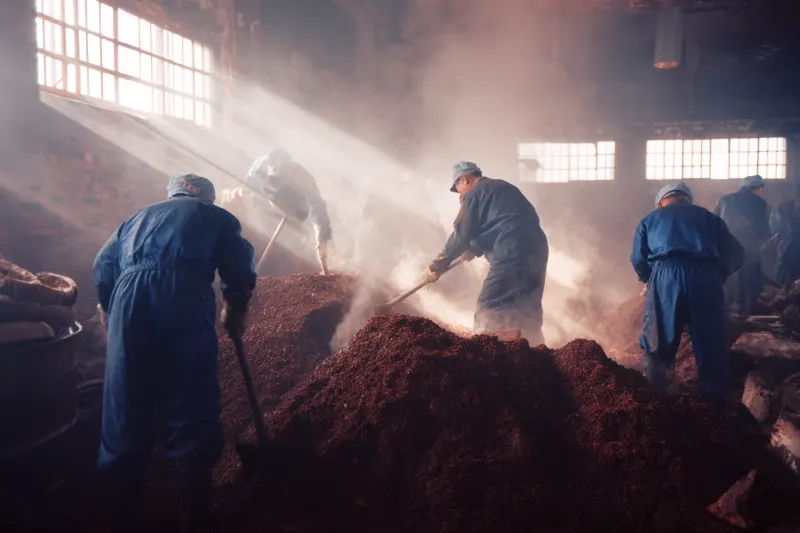
In a European distillery, a mash is usually fermented and distilled, and that is that. At Moutai the same grain mash goes round and round. It is steamed nine times. Between the steamings come eight rounds of fermentation, each one described as adding qu, piling the grain in the open to heat up, then moving it into the pit to ferment. Seven times, spirit is drawn off.
Two words in the heritage text are worth pausing on. The fermentation is "solid-state": the grain is damp but never a liquid, unlike a grape must or a beer wort. And much of the process is described as "high temperature": high-temperature qu, high-temperature piling, high-temperature collection of the spirit. Heat is not a problem to be avoided here. It is an ingredient.
And the spirit drawn off is not simply bottled.
Heat is not a problem to be avoided in Maotai. It is an ingredient.
Then, five years of patience
The heritage text lists six stages: making qu, making the spirit, storage, blending, testing and packaging. After the seven draws, the spirits are stored by type, blended, stored again, and only packed and released five years later.
So the famous calendar is really two calendars. One is the intense working year of 12987. The other is the quiet half-decade in which those separate spirits settle and are married into a single bottle. A Champagne lover will recognise the idea that blending and time on the producer's side matter as much as the harvest.
Heritage status gives this method a human face too. 季克良 (Jì Kèliáng) became the first national-level inheritor of the Moutai technique. The brewery has also spoken of seeking UNESCO recognition.
One caution for curious readers: Chinese sources and marketing often use other insider terms for this process. Some of them could not be confirmed in reliable sources, so they are left out here rather than explained badly.
The numbers belong to one brewery, but the logic of seasons, repeated fermentation and patient blending runs through much of the sauce-aroma style. It is a good doorway into baijiu as a whole, the great Chinese spirit that most European drinkers have yet to meet.
How it's made
- 1 production cycle per year.
- 2 loads of sorghum, from the Double Ninth.
- 9 steamings.
- 8 fermentations.
- 7 distillations; the spirit is released after 5 years.
How it's drunk
Moutai is China's most famous banquet spirit.
Its European cousin
Like Champagne's long production calendar, packed into a single year.