玫瑰露酒
méiguīlù jiǔ
The rose spirit behind char siu
3 min read
In 10 seconds
A sorghum spirit infused with fresh roses: the secret aroma of Cantonese barbecue.
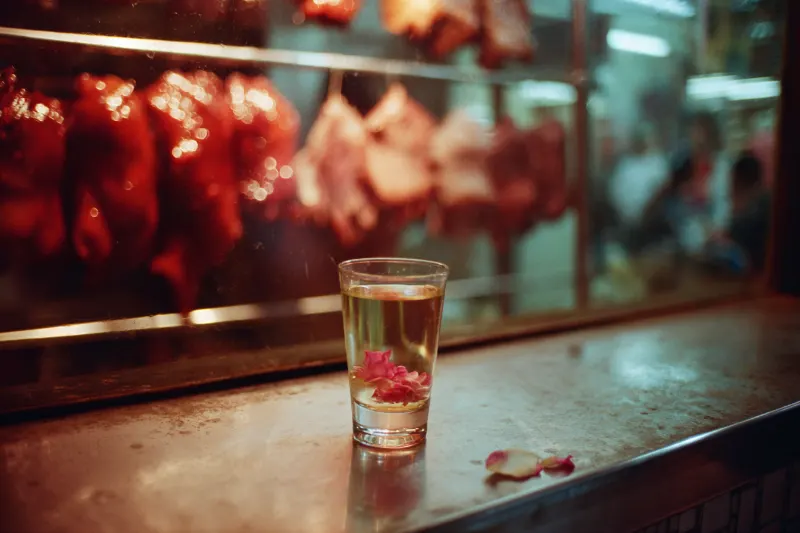
Walk past a Cantonese roast-meat window and the eye goes first to the lacquered strips of char siu, glossy and edged in red. What the eye cannot see is a bottle on the shelf behind the counter: a clear spirit that has spent time with fresh roses. Its name is 玫瑰露酒 (méiguīlù jiǔ), "rose-dew wine", and it is one of the quiet aromatic signatures of southern Chinese cooking.
A spirit, not a wine
The word *jiu* in the name misleads European readers every time. This is not a rose wine. According to the cooking site The Woks of Life, the drinking style starts from a sorghum spirit, 高粱酒 (gāoliang jiǔ), the same grain behind much of China's baijiu. Fresh rose petals and sugar go into it. The petals give up their scent, the sugar rounds the edges, and the liquid is filtered and bottled.
The same source gives two strengths. Versions made for drinking are generally above 50% ABV. Versions sold for the kitchen are usually rice-based and sit around 18%. Those numbers come from a cooking website, not from a producer or a standard, and brand-by-brand strengths have not been verified. They are a useful orientation, not a label.
For a sommelier the structure is easy to picture: a high-proof grain base, petals, and a touch of sugar. Think less of a delicate rosé and more of a strong, perfumed spirit that wants a small glass and a slow sip.
The rose inside the marinade
Where rose-dew wine really lives is the Cantonese kitchen. The Woks of Life names three places it turns up: Cantonese roast meats such as char siu (叉烧, chāshāo), cured lap cheong sausages, and soy sauce chicken. In each case a small splash goes into the marinade or the cure.
Nobody bites into a slice of char siu and thinks "roses". That is the point. The spirit works the way a dash of fortified wine works in a European ragù or a terrine: a background lift, a layer of fragrance that makes the dish taste more like itself. Alcohol carries aroma, and here it carries something floral into fat, sugar and soy.
Nobody bites into char siu and thinks "roses". That is exactly how the trick works.
For a reader who knows Mediterranean cooking, it is a familiar idea in an unfamiliar form. Marsala in the pan, cognac in the pâté, rose-scented spirit in the barbecue glaze.
What we still don't know
Honesty matters with this bottle. The research behind this guide found no heritage listing for rose-dew wine, no Chinese-language heritage source, and no verified production history. Its fame is culinary and commercial rather than documented in official records.
Availability in Europe is likewise an educated guess. Asian grocers across the continent probably stock it, given how central it is to Cantonese roast meats, but that presence has not been confirmed. Anyone looking for it should expect two kinds of bottle on the shelf, the strong drinking spirit and the gentler cooking version, and should read the label to know which is which.
The dew in the name
The word 露 (lù), "dew", carries a little history of its own. When the Ming physician Li Shizhen described distilled spirit in the 《本草纲目》 (Běncǎo Gāngmù), he called it 酒露 (jiǔlù), the "dew of wine": clear as water, extremely strong. The image of distillation as dew gathering drop by drop runs deep in Chinese writing on drink.
Rose-dew wine, then, is a dew twice over: the condensed spirit and the perfume of the flower. It sits at the meeting point of two Chinese worlds that Europeans rarely connect, the strong grain spirits of the north and the restless, aromatic kitchen of the south.
Behind this small bottle stands the whole universe of Chinese baijiu, the grain spirits distilled from sorghum and other cereals across the country. Rose-dew wine is one of its gentlest doorways: a spirit most people taste without knowing it, folded into a slice of roast pork.
How it's made
- Distil a sorghum spirit.
- Infuse with fresh rose petals and sugar.
- Filter and bottle.
How it's drunk
Neat in small glasses, or in marinades for roast meats.
Its European cousin
Like a rose liqueur, but strong, and used in the kitchen.