马奶酒
mǎnǎi jiǔ
Fermented mare's milk
3 min read
In 10 seconds
The gentlest drink of the steppe: mare's milk, churned all day until it ferments to about 2% alcohol.
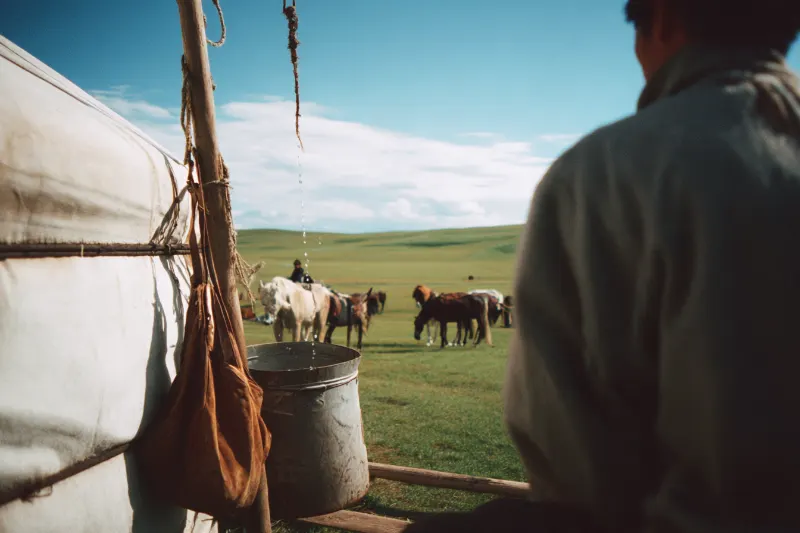
On the summer grasslands, the foal drinks first. Only when it has had its share is the mare milked, and then again an hour or two later, and again after that. The fresh milk goes into a wooden vessel or a leather bag and is shaken and churned through the day. What comes out is something between food and drink: lightly alcoholic, and offered to guests as a mark of respect.
The gentlest drink of the steppe
In Chinese it is 马奶酒 (mǎnǎi jiǔ), "horse-milk wine". Mongols call it airag; Kazakhs call it qymyz, or kymyz. In China it belongs to the pastoral cultures of Inner Mongolia and Xinjiang.
China Daily's Inner Mongolia edition gives its strength at about 1.5–3% alcohol, which makes it one of the softest fermented drinks in this whole collection. It is a summer drink, tied to the season when mares are in milk, and it is served at weddings and festivals to show respect. The same article repeats a court story: Kublai Khan is said to have offered it to an official who had got drunk at a banquet.
For a European reader, kefir is the obvious relative: a fermented milk drink rather than a wine in any sense we would recognise. The difference is the animal, and the cultural weight. Mare's milk is not a supermarket product on the steppe; it is a seasonal gift.
Churned all day
The most vivid description of the method comes from Kazakhstan rather than China, in a 2026 Euronews report, so it should be read as the Kazakh tradition in general rather than a portrait of any Chinese village.
The foal drinks first; only then is the mare milked.
Fresh milk is called *saumal*. It is churned in wooden vessels coated with butter, called *kubi*, or in leather sacks. Some sacks hang in the yurt; others are tied to a saddle, so that the ride itself does the churning. The first qymyz of the season is celebrated with its own occasion, *Kymyz Muryndyk*.
Our sources describe neither its taste nor its texture in detail, beyond the sourness that the Chinese commercial name implies: 酸马奶 (suān mǎnǎi), "sour mare's milk".
Older than history books
Mare's milk carries a very long memory. The Greek historian Herodotus mentions the Scythians and their mare's milk, and residues of horse milk have been found at Botai sites. Few drinks in this collection can claim a European classical author as a witness.
Today it lives between tradition and market. China issued its first production licence for 酸马奶 in 2020, according to a reported headline, pointing to commercial sales as a health product. Locally it is still sold and served; we know of no export to the EU.
Its stronger relative is 奶酒 (nǎijiǔ), a distilled milk spirit. China's national heritage list includes the Mongolian dairy craft known as 察干伊德 (chágān yīdé), "white food", from Zhenglan Banner in Inner Mongolia. In that tradition the whey left over from dairy work is used to make 奶酒, so that none of the milk goes to waste, and white foods are offered to ancestors and spirits.
One caution belongs in any story about this drink. Many Kazakhs are Muslim, and fermented mare's milk is a pastoral tradition, not a drink that every Kazakh or Mongol household takes.
马奶酒 sits at the far edge of what Europeans would call wine: no grape, no grain, barely any alcohol. Yet in Chinese it carries the word 酒, and in the wider map of Chinese drinks it marks the northern frontier, where the vineyard gives way to the herd and fermentation follows the seasons of the animals.
How it's made
- Let the foal suckle first, then milk the mare every 1–2 hours.
- Pour the fresh milk into a wooden vessel or leather bag.
- Churn or shake it throughout the day.
- Drink it lightly sour, within days.
How it's drunk
In summer, offered to guests and served at weddings and festivals.
Its European cousin
Like kefir, but from mare's milk.
Many Kazakhs are Muslim; mare's milk is a pastoral tradition, not a drink everyone takes.