老窖
lǎojiào
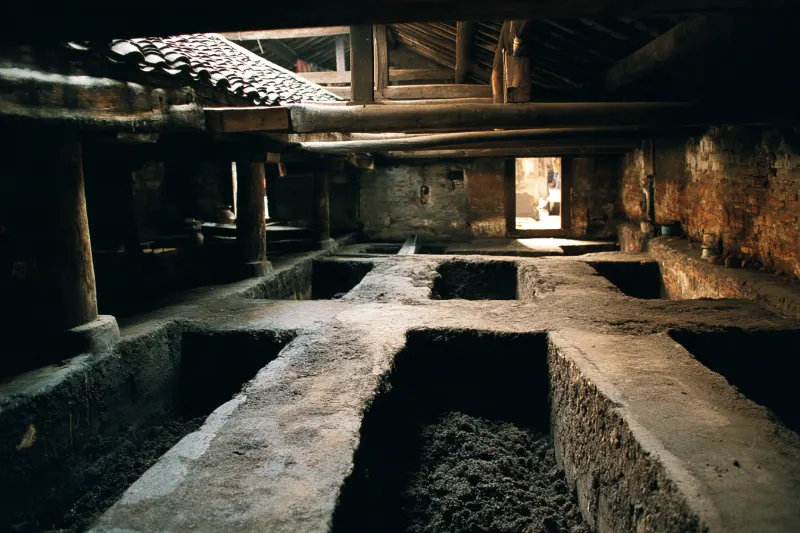
Mud pits in use since 1573
3 min read
In 10 seconds
In Luzhou, baijiu ferments in mud pits dug in 1573. The mud is alive, and it smells of pineapple.
In 1573, in the reign of the Ming emperor Wanli, workers in Luzhou, Sichuan, dug a group of pits into the ground and lined them with local yellow mud. Grain has been fermenting in them ever since. Chinese sources describe the pits as in continuous production, "从未间断", never interrupted. More than four centuries on, the mud inside them is still at work.
A hole in the ground as a winery
Strong-aroma baijiu is fermented not in tanks or barrels but in pits. In this style, 浓香 (nóngxiāng), steamed sorghum is mixed with the starter, qu 曲 (qū), and packed into earthen pits lined with clay. There it ferments as a damp solid mass before it is distilled. Then the pit is filled again.
A European winemaker would empty a vat, scrub it and start again. A Luzhou brewer does the opposite. The pit is never meant to be clean. Every cycle leaves something behind in the mud, and over years the walls stop being a container and become an ingredient.
The life in the mud
Microbiologists have looked closely at what lives in these walls. A 2022 study in the journal Foods, on pit mud from strong-aroma baijiu, describes bacteria of the class Clostridia, including *Clostridium* and *Caproiciproducens*, as primary producers of short- and medium-chain fatty acids. One of them is caproic acid, 己酸 (jǐsuān).
In the pit, caproic acid meets alcohol and forms ethyl caproate, 己酸乙酯 (jǐsuān yǐzhǐ). This is the signature aroma of strong-aroma baijiu: fruity, ripe, often compared to pineapple. The study found that the more of these bacteria in the mud, the more caproic acid and ethyl caproate. It also found key aroma compounds were higher in mature pit mud than in young mud, and put it plainly: "Aged pit mud has a strong aroma whereas aging pit mud does not." Even inside one pit, the mud is not uniform. The bottom layer supported good-quality spirit; the upper layer did not.
A 2025 study published in 《食品科学》 (Food Science), with a researcher from Luzhou Laojiao among the authors, added that the microbes and flavour compounds in pit mud shift with the season and the layer.
The pit is never meant to be clean. Over the years, the walls stop being a container and become an ingredient.
For a European reader, the closest comparisons are living cultures handed down through time: a sourdough mother, or the veil of flor that grows on fino sherry. In both cases what matters is not only the raw material but the community of microbes that has settled in. In Luzhou, that community lives in the walls.
A relic that still works
The 1573 pits, known as the 1573国宝窖池群 (1573 Guóbǎo jiàochí qún), give their name to the Guojiao 1573 brand. In 1996 the State Council listed them as a national key cultural relic protection unit, the first site of the baijiu industry to receive that status. In 2013 the listing grew to include 1,619 pits over a hundred years old, 16 workshops from the Ming and Qing dynasties and three natural storage caves. In 2018 they joined the second batch of national industrial heritage.
The site also appears on China's tentative list for World Heritage, as part of the country's baijiu sites. Luzhou Laojiao's brewing technique was in the first batch of national intangible heritage, and the company traces its craft lineage back to 1324.
A note of honesty is useful here. "Continuous use since 1573" is how the sources describe the pits; the science above shows that old, mature mud carries more aroma-making bacteria than young mud. No study cited here dates the microbes themselves. The romance of centuries-old bacteria is plausible, but it is an inference, not a measurement.
What is beyond doubt is the idea. In Burgundy, terroir is soil and slope. In Luzhou, a large part of the terroir is a living wall of mud that brewers have been feeding, cycle after cycle, since 1573.
Pit mud is one answer to a question every Chinese spirit has to settle: what does the grain ferment in? Others choose stone, buried jars or something else entirely, and that choice is one of the clearest keys to tasting baijiu, style by style.
How it's made
- Line a pit with clay mud.
- Fill with steamed sorghum mixed with qu.
- Seal the top with mud and ferment.
- Distil, then reuse the pit; over decades the mud grows richer in microbes.
How it's drunk
The style is strong-aroma (浓香) baijiu, China's most-drunk type.
Its European cousin
Like a sourdough mother or sherry's flor: living microbes are the real terroir.