洞藏
dòngcáng
Baijiu aged in caves
3 min read
In 10 seconds
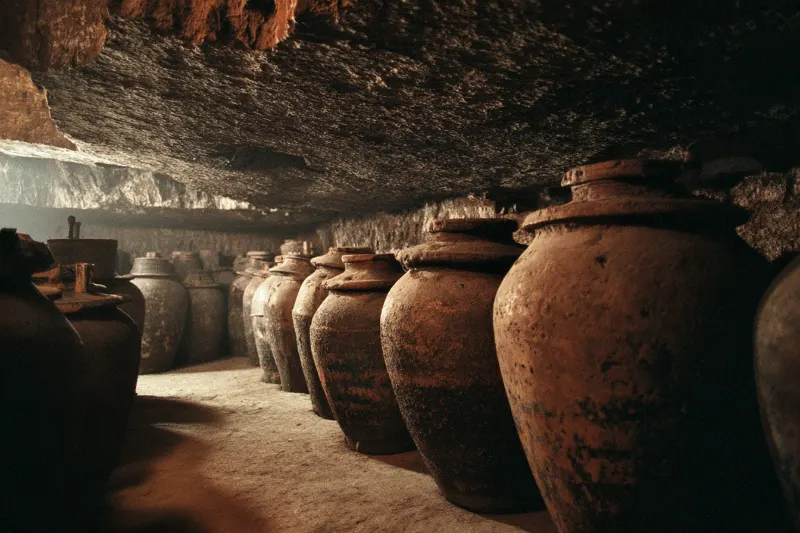
Above the Chishui River, Langjiu ages baijiu in clay jars inside natural caves.
Above the Chishui River 赤水河 (Chìshuǐ Hé), in natural caves out of the sun and the weather, stand huge ceramic jars, each closed with a flat ceramic cap and marked with a year. The work being done here is the quietest part of making baijiu: waiting.
The river and the town
The caves belong to Langjiu 郎酒 (Lángjiǔ), a producer based in Erlang town, in Gulin county, part of the city of Luzhou in Sichuan. The Chishui is the same river that shapes the calendar at Moutai, and Langjiu works in the same broad family of sauce-aroma baijiu, 酱香 (jiàngxiāng), the style that Moutai made famous.
Where Langjiu sets itself apart is storage. It ages its spirit in clay jars inside natural caves, a practice known in Chinese as 洞藏 (dòngcáng), "cave storage". Three caves appear in recent reporting: 天宝洞 (Tiānbǎo Dòng), 地宝洞 (Dìbǎo Dòng) and 仁和洞 (Rénhé Dòng). The names have a pleasing symmetry: Tianbao and Dibao read roughly as "Heaven's Treasure" and "Earth's Treasure".
Inside Tianbao Cave
The best known is Tianbao Cave. Showcaves, a website that catalogues caves around the world, gives its area as 14,200 m² and describes Langjiu's caves as "the largest natural liquor-storage caves in the world". That superlative comes from a secondary source rather than from an official measurement, and is best read as such.
The same source describes the conditions inside simply as "constant warm and moist". It gives no figures, and no official temperature or humidity readings from Langjiu were found either. So there are no numbers here: only the principle that a cave does not swing with the seasons the way a warehouse does.
In a cave, the year has no seasons. That is the whole point of putting a spirit there.
Any European who has walked through the chalk cellars under Reims, or seen cheese ripening in the caves of Roquefort, will understand the instinct. Underground, the climate holds steady, and what is stored there changes slowly and evenly.
Does the vessel change the spirit?
It is tempting to say exactly what years in a cave do to baijiu. The honest answer is that no published study on Langjiu's caves turned up in the sources used here.
There is, however, a useful clue from elsewhere in China. Research published in 2022 in the journal 《食品科学》 (Food Science) compared baijiu stored in the traditional wicker-and-paper vessels of northern China, called 酒海 (jiǔhǎi), with baijiu stored in ceramic jars and stainless steel. The stored spirits ended up chemically different. That study is not about caves, but it confirms what every wine lover already suspects: what a spirit rests in is not neutral.
Langjiu is not alone in using natural storage either. Elsewhere in Luzhou, the 2013 national relic listing for Luzhou Laojiao's historic pits also included three natural storage caves. Cave ageing, in other words, is part of the landscape of Sichuan baijiu.
Buying a piece of the cave
The caves are also a selling point. In 2026, Sichuan provincial media reported that Langjiu had opened exclusive purchase rights for old cave-aged liquor from Dibao, Tianbao and Renhe caves. A jar resting in the dark has become, in part, a story that can be bottled.
For the curious drinker, that is the right way to approach it. The cave is real, the jars are real, and the stability of an underground cellar is a principle any cellar master in Champagne would recognise. The precise effect on what ends up in the glass is still waiting for its published evidence.
Fermentation, distillation and ageing each have their own Chinese solutions, from mud pits to buried jars to paper-lined baskets and caves. Following them one by one is the best way to see that baijiu, often treated in Europe as a single fiery spirit, is really a whole landscape of styles.
How it's made
- Fill clay jars with new baijiu.
- Seal the jars.
- Store them in natural caves for years.
- Blend and bottle.
How it's drunk
Sauce-aroma baijiu, similar in style to Moutai.
Its European cousin
Like Roquefort or Champagne resting in natural caves.