看花摘酒
kàn huā zhāi jiǔ
Reading strength from the bubbles
3 min read
In 10 seconds
Before hydrometers, Chinese distillers judged a spirit's strength by its bubbles.
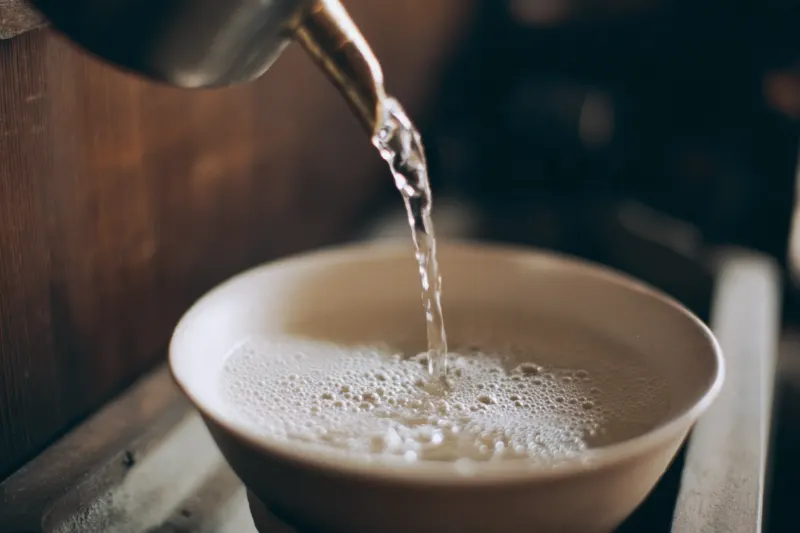
The new spirit runs from the still in a thin, clear stream. The traditional distiller does not reach for an instrument, but watches. When the spirit splashes or is poured, it throws up a froth of bubbles, and in their size and their lifespan the distiller reads how strong the spirit is, and when to stop collecting it. The Chinese name for this is lovely: 看花摘酒 (kàn huā zhāi jiǔ), "watch the flowers, pick the spirit".
Heads, heart and tails
Every distiller in the world faces the same problem. What comes off a still is not one liquid but a sequence. The first part, the heads, is harsh and volatile. The last part, the tails, is weak and heavy. The good spirit, the heart, sits in between. A cognac or grappa maker makes exactly this cut, and so does a baijiu distiller.
Chinese heritage texts describe the rule in four characters. Xifeng's national heritage record, for the spirit of Fengxiang in Shaanxi, speaks of 掐头去尾 (qiā tóu qù wěi), cutting off the head and removing the tail, and keeping the middle. Moutai's heritage text lists "high-temperature collection of the spirit", 高温摘酒 (gāowēn zhāi jiǔ), among its defining techniques. And the traditional term for cutting the distillate by its quality is 量质摘酒 (liàng zhì zhāi jiǔ): judging and sorting the spirit as it flows, partly by taste.
The question is how to know where to cut, without a laboratory.
Reading the flowers
The answer, in traditional Chinese distilling, is the 酒花 (jiǔhuā), literally "liquor flowers": the bubbles that form when the spirit is shaken, splashed or poured. Xifeng's heritage record says that throughout the process distillers rely on their senses, and names this specifically: observing the liquor flowers while cutting the spirit.
The principle is simple and documented. A very strong spirit throws up large bubbles that vanish almost at once. As the strength falls, the bubbles become smaller and linger longer. With experience, a distiller can see the strength slipping away as the run goes on.
In the size of a bubble and the time it takes to die, a distiller reads the strength of the spirit.
Popular Chinese guides describe the progression with kitchen images: bubbles as big as soybeans at the strongest, then the size of mung beans, then as small as grains of rice, piling on top of one another and lasting longer. These guides also attach strength ranges to each size. The figures come from a low-authority consumer source, which itself warns that bubble-reading is a supplementary check, not the deciding factor. So they are not repeated here.
What remains unverified
Books and websites on baijiu often go further, giving each type of bubble its own traditional name. Those names could not be confirmed in any reliable academic or producer source, so they are left out on purpose. The same goes for detailed accounts of exactly how the spirit is caught and dropped to raise the bubbles. They may well be accurate; they are simply not documented well enough to print as fact.
What can be said safely is this: distillers judge strength by eye. Big, clear bubbles that pop at once mean very strong spirit. Small bubbles that linger mean the strength is falling. And Xifeng, at least, has written that skill into the official description of its heritage craft.
For a European wine taster the gesture will feel familiar. Swirling a glass and watching the legs run down the side is also a way of reading a liquid with the eyes before the nose and palate. The difference is that a Chinese distiller does it under pressure, at the still, and the decision changes what ends up in the bottle.
Before hydrometers, the liquor flowers gave Chinese distillers a way to measure with their eyes, and they still sit in an official heritage text today. They are a small window into a much larger story: Chinese drinks were shaped as much by trained eyes, hands and noses as by any written recipe.
How it's made
- Catch the spirit as it flows from the still.
- Shake or pour it.
- Watch the size of the bubbles and how long they last.
- Decide where to cut heads, heart and tails.
How it's drunk
A method used during distillation.
Its European cousin
Like a winemaker reading the legs on a glass, but used to cut the spirit.