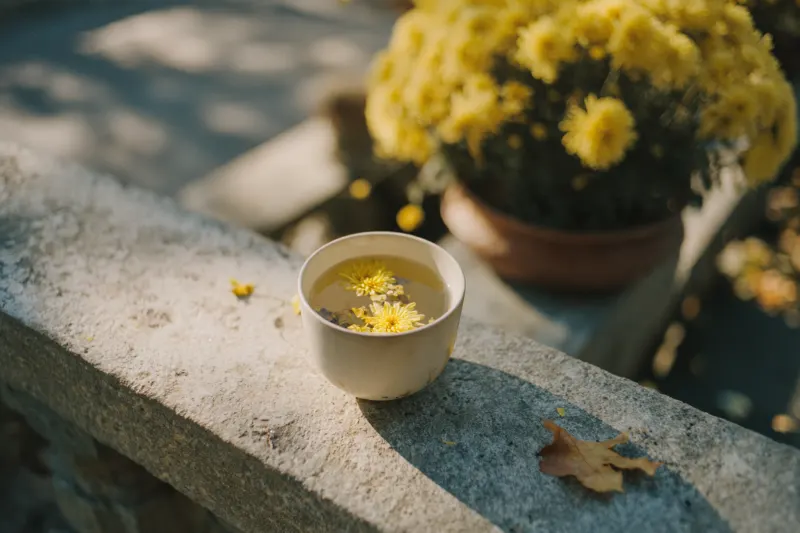
菊花酒
júhuā jiǔ
Chrysanthemum wine for a long life
3 min read
In 10 seconds
Two thousand years ago, on the ninth day of the ninth month, people drank chrysanthemum wine to live longer.
In autumn, when the chrysanthemums open across China, one date stands out on the lunar calendar: the ninth day of the ninth month, 重阳 (Chóngyáng), the Double Ninth. For more than two thousand years, people have marked it by wearing a sprig of dogwood, eating cakes and raising a cup of 菊花酒 (júhuā jiǔ), chrysanthemum wine, to a long life.
Written down in the Han dynasty
The oldest clear record of the custom is in the 《西京杂记》 (Xījīng Zájì), a late Western Han collection attributed to 刘歆 (Liú Xīn). Its line is short and precise:
"九月九日,佩茱萸,食蓬饵,饮菊花酒,云令人长寿。"
On the ninth day of the ninth month, people wore 茱萸 (zhūyú), dogwood, ate 蓬饵 (péng'ěr), a kind of cake, and drank chrysanthemum wine, which was said to make people live long. A China Daily feature on the festival lists brewing chrysanthemum wine and admiring chrysanthemums among the customs of the day.
On the ninth day of the ninth month, they drank chrysanthemum wine, which was said to make people live long.
The promise is the heart of it. This was never simply a pleasant autumn drink. It was a toast with a purpose, made at the turn of the year towards winter.
Older than the festival
The link between chrysanthemums and wine goes even deeper than the Han. In a landmark 2004 study led by the archaeochemist Patrick McGovern, researchers analysed liquids that had survived inside sealed bronze vessels from Anyang, the Shang capital, and from the Changzikou tomb in Henan. They date to around 1250–1000 BC.
The liquid survived because the bronze lids had corroded shut. Inside were rice or millet wines, or the herbal drink called 鬯 (chàng), flavoured with wormwood, tree resins and chrysanthemum flowers. McGovern later recalled the fragrant aroma of those liquids in their tightly lidded vessels.
For a European reader, the point is simple: about three thousand years ago, someone in China was already putting chrysanthemum into wine.
Not one recipe, but a custom
The sources describe chrysanthemum wine as a festival practice, not a single fixed product. What is constant is the flower, the date and the wish. The base wine, the method and the strength vary, and no source consulted gives an alcohol content.
Regional versions of a Double Ninth wine survive too. Among the Qiang people of Sichuan, the national heritage site describes a 重阳酒 (chóngyáng jiǔ) brewed at the Double Ninth, aged for more than a year until it turns purplish-red. It is a different drink, but it shows how the date itself became a moment to brew.
Other flower wines sometimes get attached to the festival. One China Daily article also mentions osmanthus wine at the Double Ninth, which sits awkwardly beside its own Han quotation; osmanthus is more often linked to Mid-Autumn. The chrysanthemum is the one the early text names.
A sommelier's view
Europe has its own flower-scented drinks, from elderflower liqueurs to the herbal liqueurs of monastic tradition. What makes chrysanthemum wine different is that it is tied to a single day and a single wish. It is closer to a ritual than to a style.
Today flower-flavoured wines are sold in China, but they are not a common export. The tradition itself travels more easily: a cup raised in autumn, for the health of the oldest people at the table.
Chrysanthemum wine sits within the long story of Chinese rice wine, one of the oldest fermented traditions in the world. From sealed Shang bronzes to modern festival tables, flowers and herbs have flavoured that story from the very beginning.
How it's made
- A festival custom.
- Wine flavoured with chrysanthemum flowers is prepared.
- It is drunk on the Double Ninth Festival, with dogwood and cakes.
How it's drunk
On the Double Ninth Festival (重阳), in autumn.
Its European cousin
Like a toast to long life with a flower-scented wine.