九阡酒
jiǔqiān jiǔ
A starter made from 103 wild plants
3 min read
In 10 seconds
Shui women make their wine starter from up to 103 wild plants. Parents once buried the wine when a daughter was born.
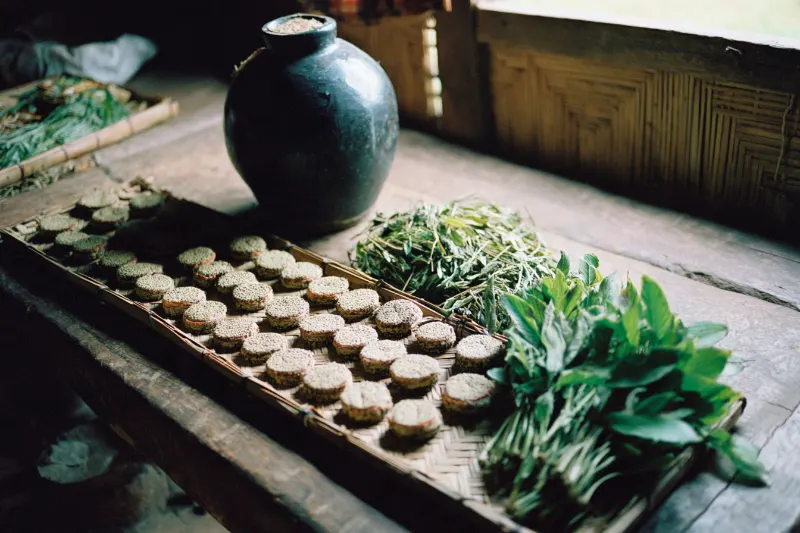
In the Shui villages of Sandu, in southern Guizhou, a starter for wine is not bought. It is gathered. The plants come from the wild. They are dried and ground, boiled in spring water, and press the result into cakes the size of an egg. One of these cakes may hold the knowledge of dozens of plants. Researchers who counted them across twenty villages arrived at a number that stops any winemaker in their tracks.
A hundred and three plants
The wine is 九阡酒 (jiǔqiān jiǔ), from Sandu Shui Autonomous County, 三都水族自治县. It is made from glutinous rice (CGTN describes red glutinous rice; the Shui grow fifteen varieties and especially value the black one), spring water and a hand-made starter.
That starter is the reason scientists came. Between 2012 and 2014, ethnobotanists led by Hong and Long worked in 20 Shui villages with 149 informants. Their study, published in 2015 in the *Journal of Ethnobiology and Ethnomedicine*, recorded the plants used in the Shui 小曲 (xiǎoqū), a small-cake starter.
103 wild plant species, from 88 genera and 57 families, in one tradition of hand-made starter.
The most often cited include *Gerbera piloselloides*, *Lygodium japonicum* and *Rosa roxburghii*, the prickly chestnut rose, 刺梨 (cìlí). The plant powder is boiled for hours in spring water, mixed with rice bran, rice flour and a little of last year's starter, then warmed for a week and dried. The finished cakes keep for up to three years. Like a sourdough mother, each year's starter is seeded from the one before.
Half concentrated, half distilled
What happens next makes 九阡酒 unusual even in China. The rice is soaked, steamed and left to turn sweet in a wooden cask set in a pit, then fermented with spring water for about two weeks. At that point the makers split the batch. One part is concentrated; the other is distilled. Then the two are blended together.
For a European palate the idea has a familiar shape: a fermented wine strengthened with its own spirit, a little like a fortified wine, though made by entirely different means. No source we have read gives its strength or describes its taste in detail, so we will not invent one.
Finally the wine goes underground. It ages for years in pottery jars buried in the earth, where the study records a temperature of 13–18 °C. Georgian qvevri come to mind, though those hold fermenting wine rather than a finished blend.
A wine for a daughter
According to CGTN, Shui parents once brewed and buried wine when a daughter was born, and dug it up to serve at her wedding. The same broadcaster tells a more modern burial story: for the Olympic bid of 2001 the Shui prepared and buried 99 bottles, which were taken to Beijing in 2008 as the "official blessing wine" of the Games. CGTN is the only source we have for this, and for the wine's listing as provincial intangible heritage in 2009, so both should be read as reported rather than confirmed.
The study adds everyday customs: a shared cup passed around the table, 转转酒 (zhuànzhuàn jiǔ); wine for women after childbirth; and drinking at the 端节 (Duānjié), the Shui festival held in the ninth lunar month.
Knowledge on the move
Women are the main makers, and the knowledge passes from mother to daughter. That is exactly why it is fragile. The researchers list the threats plainly: young women leaving the villages for work, commercial starters replacing wild ones, and over-harvesting of the plants. Production today ranges from households to small distilleries, and quality is inconsistent. A tradition built on a hundred plants can disappear one forgotten plant at a time.
九阡酒 belongs to the broad family of Chinese rice wines, but it also points toward China's spirits, since part of every batch passes through a still. Above all it shows how much of Chinese drinking culture lives in the starter: a small dry cake that holds a landscape, a calendar and a line of women stretching back through generations.
How it's made
- Boil powdered plants in spring water for 3 hours; mix with bran, rice flour and last year's starter.
- Shape egg-sized cakes, incubate at 28–30 °C for 7 days, then dry (they keep up to 3 years).
- Soak glutinous rice for 24 hours, steam it and let it turn sweet in a wooden vat set in a pit for 2 days.
- Add water and ferment for about 15 days.
- Concentrate one part, distil the other, blend them and age underground in clay jars at 13–18 °C.
How it's drunk
At family celebrations. Tradition says wine buried at a daughter's birth was opened at her wedding.
Its European cousin
Like a sourdough mother with a hundred wild herbs, aged underground like Georgian qvevri wine.