贾湖
Jiǎhú
The world's oldest known alcoholic drink
3 min read
In 10 seconds
About 9,000 years ago, people in Jiahu were drinking a mix of rice, honey and fruit. It is the oldest chemically confirmed alcoholic drink.
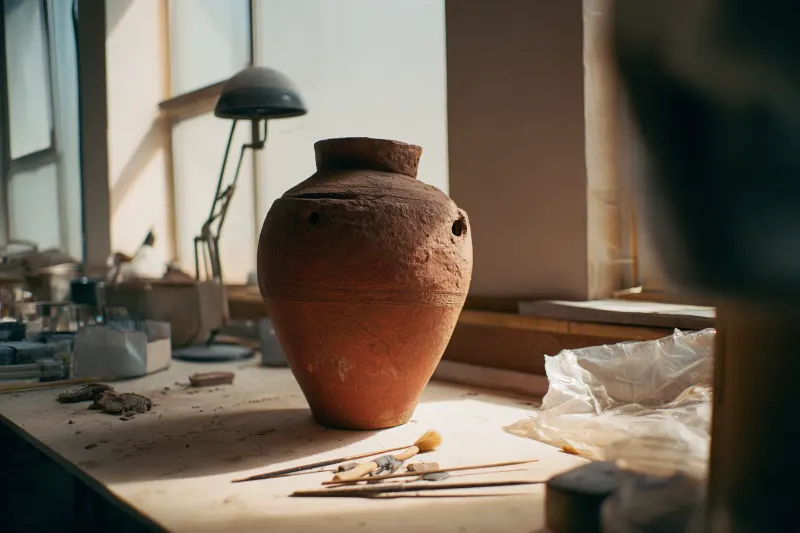
About 9,000 years ago, in a Neolithic village in what is now Henan province, someone poured a drink into a pottery jar. It was made from rice, honey and fruit, and it had fermented. A trace of it survived on the pottery, waiting for scientists with instruments sensitive enough to read it. What they found is, as far as anyone has been able to prove, the oldest alcoholic drink in the world.
A cocktail from the Stone Age
The village is Jiahu, 贾湖 (Jiǎhú). Pottery jars from the site held the chemical traces of a mixed fermented drink. Three ingredients stood out: rice; honey, revealed by compounds from beeswax; and fruit, identified through tartaric acid, which points to hawthorn, wild grape, or both.
That makes it neither a beer nor a wine in the European sense, but something in between: part grain drink, part mead, part fruit wine. Guinness World Records lists it as the "oldest alcoholic beverage". Researchers placed it at roughly the same age as the earliest barley beer and grape wine known from the Middle East.
A word on dates. The drink is usually described as about 9,000 years old. More precise ranges are quoted in various places, but they could not be checked against the original paper for this article, so "about 9,000 years" is the honest figure.
How a residue becomes a recipe
The study was published in 2004 in PNAS, the Proceedings of the National Academy of Sciences, under the title "Fermented beverages of pre- and proto-historic China". The lead author was Patrick E. McGovern of the Penn Museum, working with the Chinese archaeologist 张居中 (Zhāng Jūzhōng) and Chinese, American and European co-authors.
The team used a battery of laboratory techniques, including gas and liquid chromatography combined with mass spectrometry, infrared spectrometry and stable isotope analysis. In plain terms: they broke the residue down into its molecules, identified them one by one, and matched them to their likely sources. The Penn Museum announcement called it "the first direct chemical evidence for early fermented beverages in ancient Chinese culture".
Wines still sealed in bronze
The same research produced a second, almost unbelievable finding. In tombs from the Shang and Western Zhou dynasties, dated to about 1250–1000 BC, some bronze vessels still held liquid. Their lids had corroded shut, sealing them like a stopper and preventing evaporation. The samples came from Anyang, the Shang capital, and from the Changzikou 长子口 (Chángzǐkǒu) tomb in Luyi County, Henan.
Three thousand years after the lids corroded shut, the wine was still inside.
The liquids turned out to be rice or millet wines, 酒 (jiǔ), or the herbal drink called 鬯 (chàng), flavoured with wormwood, chrysanthemum flowers and tree resins such as China fir and elemi. That matches herbal wines named in Shang oracle-bone inscriptions. McGovern later recalled "the fragrant aroma of the liquids inside the tightly lidded jars and vats".
For European readers there is a familiar echo. Wormwood is the bitter herb behind vermouth and absinthe; resin is still added to Greek retsina. Ancient China was flavouring its fermented drinks with similar plant materials.
How was it made?
Rice does not ferment easily on its own: its starch has to be broken down into sugar first. The researchers suggested that the method was probably mould saccharification, the principle behind qu 曲 (qū), the starter still used across China. Moulds turn starch into sugar, while yeasts arrive by chance, carried by insects or living in the rafters of old buildings. Modern qu can contain up to about 100 herbs, and some herbs have been shown to raise yeast activity as much as sevenfold.
Whether the people of Jiahu already used something like qu, or relied on honey and fruit to start the fermentation, is not settled by the residues alone. What the evidence does show is a drink built from several ingredients, about 9,000 years ago.
That thread runs unbroken to the present. A Han-era text, 《西京杂记》 (Xījīng Zájì), records chrysanthemum wine drunk at the Double Ninth Festival for long life, and herbal starters made with dozens of wild plants are still a living, if fragile, craft in south-west China today. Every glass of Chinese wine or spirit carries, somewhere in its family tree, the memory of a jar at Jiahu.
How it's made
- Archaeologists analysed residues in Neolithic pottery.
- They found markers of rice, beeswax (honey) and fruit acids.
- They also tested liquids sealed in bronze vessels from the Shang dynasty.
How it's drunk
Probably in rituals and burials.
Its European cousin
About a thousand years older than the earliest grape wine traces found in the Caucasus.