红曲酒
hóngqū jiǔ
The red wine that turns amber
3 min read
In 10 seconds
Made with red yeast rice, this wine is ruby red when young and turns amber as it ages.
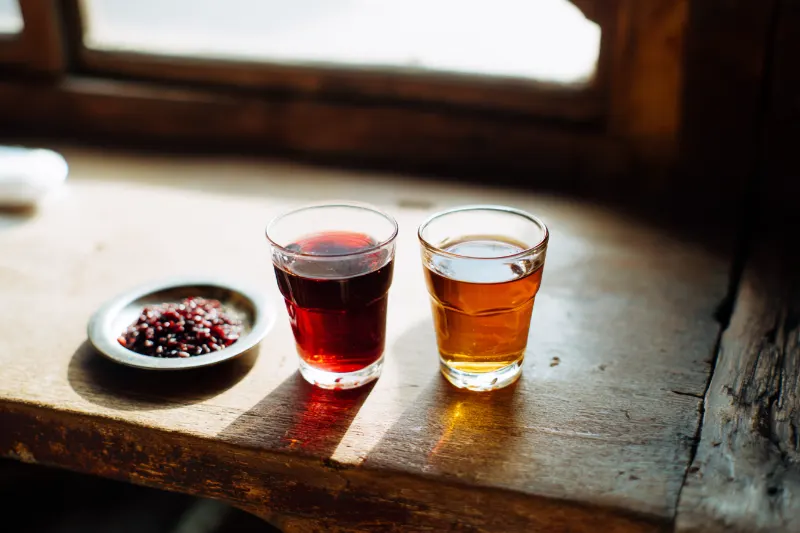
Pour two glasses side by side. One is ruby red, the colour of a young wine fresh from the jar. The other is amber, quieter, older. They are the same wine, separated only by time. That is the quiet magic of red-yeast rice wine, and it begins at dawn.
Red rice, amber wine
The drink is 红曲酒 (hóngqū jiǔ), known in the heritage records as 红粬黄酒 (hóngqū huángjiǔ), "red-qu yellow wine". It is fermented with 红曲, rice that has been inoculated with a red mould, *Monascus*. In 2021 its brewing technique entered the fifth batch of China's national intangible heritage list, declared by 屏南县 (Píngnán Xiàn), Pingnan County, in the Ningde area of Fujian.
The heritage listing describes a striking life cycle. The new wine is red and slightly pungent. In sealed storage it turns yellow or amber and grows more aromatic, a change the listing attributes to the Maillard reaction. For a European palate the parallel is a ruby wine that slowly becomes tawny; the comparison is ours, but the colour shift is documented.
New wine is red; old wine turns amber.
The technique is said to be more than a thousand years old. Its core areas are Pingnan, Gutian and Jiaocheng, and the listing traces its spread across Fujian, Zhejiang, Guangdong, Jiangxi, Taiwan and the Chinese communities of South-East Asia. Red yeast itself, the listing adds, is used both as food and in traditional medicine.
Nine steps, from dawn to embers
What makes this wine unforgettable is the home method recorded by the heritage listing. It runs in nine steps, and each one feels like a scene.
Water is drawn at dawn. The rice is soaked and rinsed, then steamed, and the listing insists on the fire: it should be pine wood. The rice is cooled, mixed with red yeast in the jar and stirred as it ferments. The wine is pressed, and the new wine is tasted. Then comes the most beautiful gesture of all, 煨酒 (wèi jiǔ): the wine is warmed over burning rice husks. Only then is it cellared.
The listing names the points where skill matters most: the pine fire, the cooling time, the fermentation temperature and judging the heat of the husk embers. It is a craft of attention rather than machinery, the kind of knowledge that lives in hands.
Seventy-two herbs in Jinhua
The red-yeast tradition is not limited to Fujian. In Jinlan Village, in the Wucheng district of Jinhua, Zhejiang, China Daily profiled Zhang Xuehong, a county-level heritage inheritor. Her order of work is simple: water first, then 红曲, then steamed glutinous rice. The vat is sealed for about a month and turns red.
Her starter is anything but simple. It contains 72 medicinal herbs, among them 杜仲 (dùzhòng) and 当归 (dāngguī). The finished wine is served at the New Year and described as amber, sweet and fragrant. That is one of the few direct descriptions of taste our sources offer, and it is worth keeping exactly as given.
What we still do not know
Fujian has a group standard for the drink, 《福建红曲酒》 (Fújiàn Hóngqū Jiǔ), in force since 2022, though its contents were not reviewed for this story. And one question remains open. One point has been flagged in our research but not yet verified: red yeast can produce compounds such as citrinin and monacolin K, and monacolins may be regulated in Europe in the context of supplements. This is a point to check, not a conclusion; it is mentioned here because honesty about open questions is part of a good tasting note.
The same red yeast runs through other wines on this site: the 沉缸酒 of Longyan, whose name recalls lees that sink and rise, and the 马祖老酒 of the Matsu Islands. Together they draw a red line through southern Chinese rice wine, a family worth exploring glass by glass, from ruby to amber.
How it's made
- Draw water at dawn and wash the rice.
- Steam it over a pine-wood fire.
- Mix with red yeast rice in a jar and ferment.
- Press and taste the new wine.
- Warm it over smouldering rice husks (煨酒) and store it.
How it's drunk
Warm, with food; also used in cooking.
Its European cousin
Like a ruby Port that turns tawny with age.