高山流水
gāoshān liúshuǐ
The Miao wine waterfall
3 min read
In 10 seconds
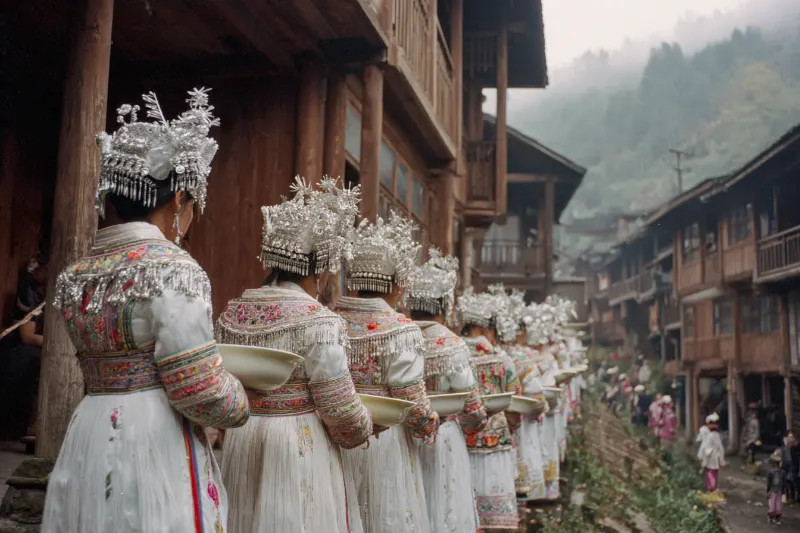
A line of women pours rice wine from one bowl to the next, until the waterfall reaches the guest's mouth.
Imagine standing at the foot of a line of women, each one a step higher than the next, each holding a bowl of rice wine. The woman at the top tips her bowl into the one below; that one pours on, and so on down the line, until the last bowl reaches your lips. The wine keeps coming. This is 高山流水 (gāoshān liúshuǐ), "high mountains, flowing water", the most theatrical welcome in Miao country.
A toast with a poetic name
The custom belongs to the Miao people of Guizhou, and today it is most closely associated with 西江千户苗寨, the Xijiang Thousand-Household Miao Village in Leishan 雷山 (Léishān) county. According to a report in The Paper, young Miao women stand in a line from high to low, each with a vessel, and pour rice wine in sequence so that it cascades into the guest's mouth.
Chinese readers will know the four characters from other contexts, but here they describe neither scenery nor music. They name the toast itself: the hosts as the mountain, the wine as the stream, the guest at the bottom of the valley.
For a European, the nearest gesture is perhaps the Catalan porrón, the glass flask whose thin spout sends a stream of wine into an open mouth. The Miao version turns that single arc into a human waterfall, and turns a personal skill into a collective act of welcome.
Xijiang, on stage
Here honesty matters more than romance. At Xijiang, 高山流水 is now experienced mainly in two places: in Miao restaurants that serve tourists, and as one segment of the staged show 《神秘苗疆》 (Shénmì Miáojiāng), "Mysterious Miao Land", in which the audience is invited to take part. A China Daily photograph from 30 December 2023 shows the cascade as a performance watched by tourists, and its caption calls it exactly that.
A real custom of welcome, today experienced mostly as a staged one.
That is not a reason to dismiss it. Many European folk traditions also live on today through festivals and performances. But a reader should know what they are looking at: a hospitality custom rooted in village life, now packaged for visitors.
The wine at the gate
The cascade has a sibling. 拦门酒 (lánmén jiǔ), "blocking-the-door wine", also called 拦路酒 (lánlù jiǔ), "blocking-the-road wine", is a welcome at the village entrance among the Miao and also the Dong. In spirit it is simple: the guest is stopped and must drink before entering.
At Xijiang it has been turned into a product. The village promotes 十二道拦门酒 (shí'èr dào lánmén jiǔ), "twelve barriers of blocking wine", as a visitor experience, and since late 2023 it has been packaged with the cascade toast as part of a winter-tourism revival. Tourists also meet 拦门酒 during meals in Xijiang restaurants.
What our sources do not tell us is just as important. None of them describes the traditional village sequence in detail: how many barriers a village once set, which songs belonged to them, or what the guest was expected to do. Among the Dong, a 2026 Xinhua report describes road-blocking songs, 拦路歌 (lánlù gē), still sung for visitors at the drum towers of Congjiang, though it does not mention wine. The rice wine served at these welcomes is local, and no source gives its strength.
How to read what you see
If you see 高山流水 in Guizhou, it will most likely be in a restaurant or under stage lights. Enjoy it as what it is: a real gesture of hospitality, now performed for paying guests.
Behind the cascade stands something quieter and older: the rice wine itself, brewed in the villages of Guizhou with starters of local plants. The performance is the spectacle, but the wine in the bowls belongs to one of China's richest rice-wine regions, where every welcome begins with something poured.
How it's made
- Women in festive dress stand in a descending line.
- The first pours rice wine into the second's vessel, and so on down the line.
- The last vessel pours straight into the guest's mouth.
How it's drunk
To welcome guests. Today mainly in Xijiang restaurants and in the show 《神秘苗疆》.
Its European cousin
Like the Catalan porrón pour, done as a human waterfall.