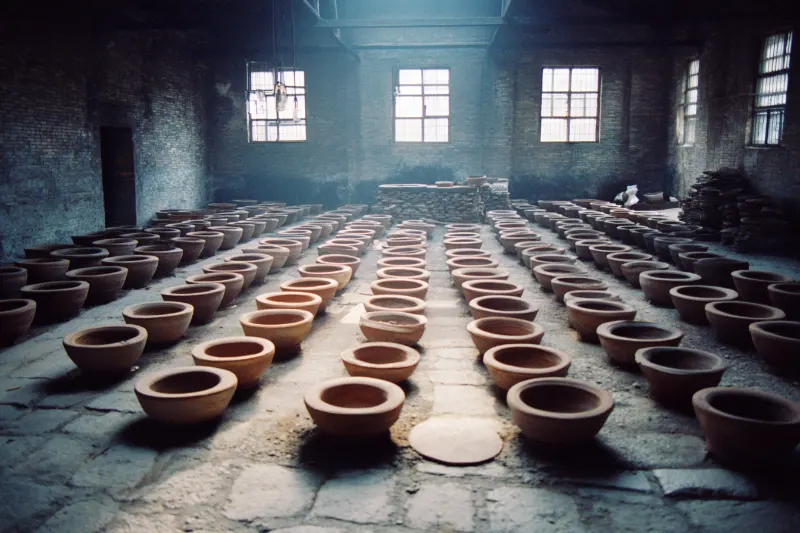
地缸
dìgāng
Fermented in buried jars
3 min read
In 10 seconds
While Sichuan uses mud pits, Fenjiu ferments its baijiu in clay jars buried in the ground. No mud, a cleaner taste.
Picture fermenting sorghum resting not in a pit of living mud but in clay jars sunk into the earth. No mud walls, no pits prized for their age. Just vessels in the ground, and grain quietly turning into something stronger. This is how Fenjiu 汾酒 (Fénjiǔ), the classic spirit of Shanxi in northern China, is made, and it is a clear sign that baijiu is not one drink but a family of very different ones.
The opposite of mud
In Sichuan, strong-aroma baijiu ferments in earthen pits whose walls are a living culture: bacteria in the old mud produce the fatty acids that become its ripe, pineapple-like aroma. Fenjiu belongs to a different school, light-aroma, 清香 (qīngxiāng), and its makers deliberately avoid that mud.
Instead they use what Chinese sources call the ancient "ground-jar" method, 地缸 (dìgāng): clay jars buried in the ground, in which the grain ferments. Because there is no mud lining, there is no pit-mud flavour. What remains is a cleaner, purer profile, which is exactly what the style is built around.
Where Sichuan cultivates its mud, Shanxi keeps it out of the jar.
A European wine lover will think at once of Georgia, where wine ferments and ages in qvevri, clay vessels buried in the ground. The parallel is visual and practical: the earth around the jar shelters what is inside. But what ferments inside is grain, not grapes.
How exactly Fenjiu's jars are made, glazed and sealed is not described in the sources used here, so those details are better left to a visit than to guesswork.
Clean steam, twice
The Fenjiu method has a name that sounds almost like a slogan: 清蒸二次清 (qīngzhēng èrcì qīng). In plain terms, the grain is steamed clean, on its own, and then fermented and distilled twice. The raw material is sorghum.
The starter is distinctive too. Fenjiu uses 青茬曲 (qīngchá qū), a qu made from barley and peas rather than the wheat qu used at Moutai. Barley and peas turn up again in another northern spirit, Xifeng from Shaanxi, whose heritage record describes a barley-and-pea starter shaped in wooden moulds. It is a reminder that northern baijiu has its own grammar, quite apart from the famous names of Guizhou and Sichuan.
For a taster, the effect of all these choices is a spirit with a clean, fresh profile. Light-aroma baijiu is often the easiest entry point for European drinkers meeting the category for the first time.
A long story, partly legend
Chinese sources trace Fenjiu's origins back to the Southern and Northern Dynasties, roughly 1,500 years ago. By the Ming and Qing dynasties it had become a distilled spirit, and in 1915 it won a gold medal at the Panama-Pacific Exposition.
The village most associated with it is Xinghua Village, 杏花村 (Xìnghuā Cūn), "Apricot Blossom Village", where old workshops are now presented as living heritage. Its fame owes much to a celebrated poem about Xinghua Village by Du Mu 杜牧 (Dù Mù). Even the China News Service article that tells Fenjiu's story admits that these legends cannot be fully verified. They are part of the spirit's identity, not part of its documented history.
What is documented is the method: buried jars, clean steaming, a double fermentation and a barley-and-pea starter. Put together, they produce a spirit that tastes clean rather than earthy.
Fenjiu and Luzhou are two poles of one country's spirit. Between them, and around them, sit sauce-aroma baijiu and many regional styles. Learning to tell a buried jar from a mud pit on the palate is one of the best first steps into baijiu, and into the wider world of Chinese drinks.
How it's made
- Steam the grain on its own.
- Mix with a barley-and-pea qu.
- Ferment in buried clay jars.
- Distil, then ferment and distil a second time.
How it's drunk
Light-aroma (清香) baijiu, often the easiest entry point for beginners.
Its European cousin
Like Georgian qvevri, buried in the ground.