侗族糯米酒
dòngzú nuòmǐ jiǔ
If you can't make it, you're not truly Dong
3 min read
In 10 seconds
Dong starters use up to 60 plant species. One villager said: if you can't make the wine, you're not a true Dong.
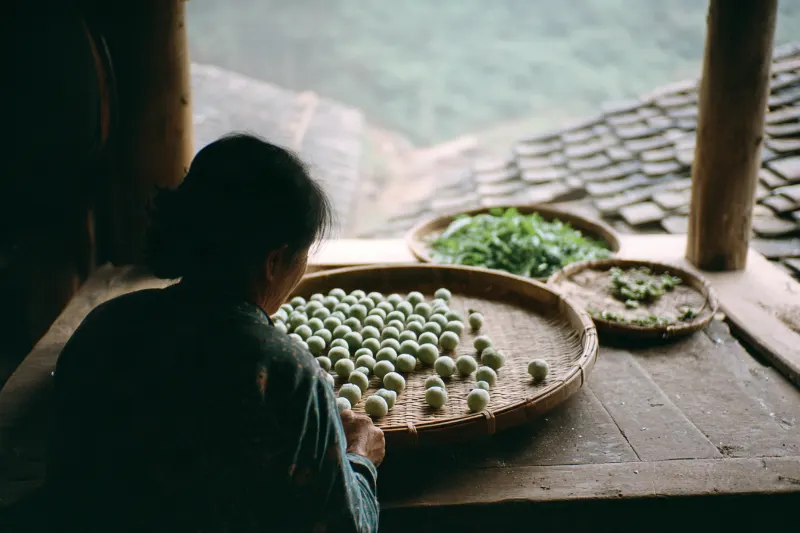
In the hill villages of south-east Guizhou, the most important ingredient of a rice wine is not the rice. It is a handful of small, pale balls, dusted with white mould, made from leaves and roots gathered on the slopes around the village. Among the Dong, 侗族 (Dòngzú), knowing how to make them is more than a kitchen skill. One villager told researchers that whoever cannot make the wine is not a real Dong.
Sixty plants in a ball
That sentence comes from a peer-reviewed study by He and colleagues, published in 2019 in the *Journal of Ethnobiology and Ethnomedicine*. The team recorded the plants used as starters for Dong glutinous rice wine, 侗族糯米酒 (dòngzú nuòmǐ jiǔ), in south-east Guizhou, 黔东南 (Qiándōngnán).
They counted 60 plant species, from 58 genera and 36 families. The most important were a mountain variety of kudzu, *Pueraria lobata* var. *montana*, and *Actinidia eriantha*, a wild relative of the kiwi. Glutinous rice itself sits among the top species, which says something about how closely starter and grain are tied.
For a European reader the closest image is the herbalist's garden of a Chartreuse or an amaro. But here the plants do not flavour a finished spirit. They feed the microbes that make fermentation possible.
How the starter is made
The study describes the method plainly. The plants are mashed and mixed with rice-husk powder. The mixture is rolled into small balls, moistened with spring water and left to ferment until white mould forms on the surface. Then the balls are dried and kept.
When the time comes, the starter goes to work on steamed glutinous rice. Mould turns starch into sugar, yeasts turn sugar into alcohol, and the wine that results is shaped by whichever plants a family or a village has chosen.
Whoever cannot make the wine, one villager said, is not a real Dong.
It is the same idea as a family sourdough mother, carried in plants instead of flour. Each starter is a small archive of the local landscape, and of the person who gathered it.
Knowledge held by elders
The study ends on a sober note. The people who know the plants and the method are mostly elders, and the researchers found that the knowledge is not being passed on. A tradition that defines who belongs to a community is, quietly, thinning out.
This is a pattern across southern China. Among the neighbouring Shui people, an earlier study counted 103 wild plants in a single starter tradition and warned of the same threats: young people leaving for work, and commercial starters replacing wild ones. The botanical wealth of these wines is real, and so is its fragility.
At the drum tower
Dong villages are known for their drum towers, and for the road-blocking songs, 拦路歌 (lánlù gē), with which visitors are welcomed. A 2026 Xinhua report shows those songs still performed for guests at drum towers in Congjiang. It is worth being precise: that report does not mention wine.
The study gives no alcohol strength, and no tasting description, so none is offered here. The wine is home-made, and nothing suggests it is exported. What the sources do offer is rarer than a tasting note: a clear picture of how a community makes its wine, and why it matters to who they are.
For a sommelier, Dong rice wine is a lesson in where terroir begins. In Burgundy it is soil and slope. Here it starts earlier, in the forest edge where someone picks the leaves.
Dong glutinous rice wine belongs to the large and varied world of Chinese rice wines, from the famous jars of Shaoxing to countless village brews. Many of them start the same way: with a starter, a handful of plants, and someone who still remembers which ones to pick.
How it's made
- Pound the plants.
- Mix with husk powder and shape small balls.
- Moisten with spring water and leave until white mould appears; dry.
- Use to ferment steamed glutinous rice.
How it's drunk
At village gatherings and when welcoming guests at the drum towers.
Its European cousin
Like a family sourdough starter kept for generations.