沉缸酒
chéngāng jiǔ
Three times down, three times up
3 min read
In 10 seconds
A red rice wine named after its lees, which sink and rise three times in the vat.
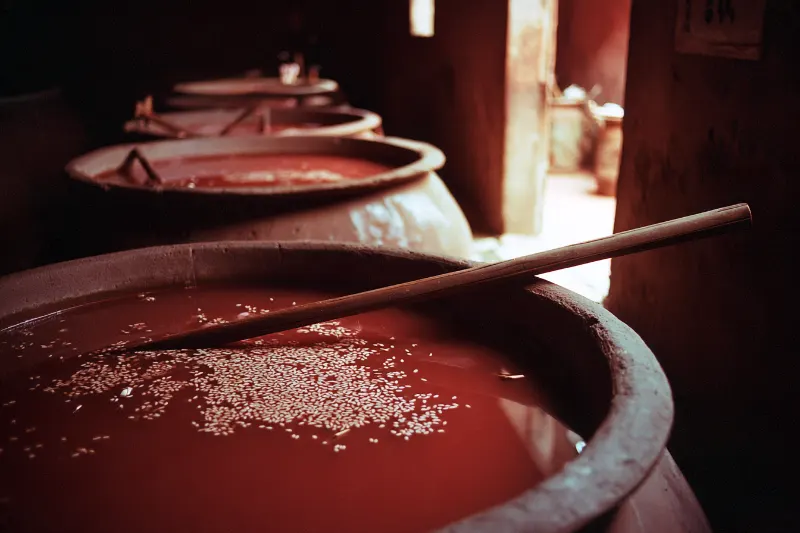
In western Fujian, a wine takes its name from movement. Down into the vat, then up again. Down, and up. Three times, the story goes, before it is ready. Few wine names anywhere describe a process so physically, and so poetically, as this one.
Three sinkings, three risings
The wine is 沉缸酒 (chéngāng jiǔ), "sinking-vat wine", from 龙门 (Lóngmén) in 新罗区 (Xīnluó Qū), Xinluo District, in the city of Longyan. In September 2026 the Fujian Provincial Government singled out its "独树一帜的'三沉三浮'古法酿造技艺": a unique, ancient brewing technique known as 三沉三浮 (sān chén sān fú), "three sinkings, three risings".
What sinks and what rises? Local tradition says it is the lees, the solid mass of rice and starter, which sink to the bottom of the vat and float back up three times before the wine is done. It is a lovely image, and it fits the name. But it is worth being precise: the official source confirms the phrase 三沉三浮, not the full explanation. The lees story belongs to tradition, and we tell it as such.
Down into the vat, then up again: three times, local tradition says, before the wine is ready.
A winemaker from Europe will recognise the drama. In a fermenting red wine, the cap of skins rises to the surface, is pushed down, rises again. The comparison is ours, not the sources', and it is only a comparison; but it shows how close the instincts of very different wine cultures can be.
A family of red wines
沉缸酒 belongs to the family of 闽西红曲酒 (Mǐnxī hóngqū jiǔ), the red-yeast rice wines of western Fujian. These are wines fermented with 红曲 (hóngqū), rice inoculated with a red mould. According to China's national heritage listing for red-yeast yellow wine, such wines are ruby red when young and turn amber as they age, a colour shift the heritage sources attribute to the Maillard reaction during sealed storage.
That gives the sommelier a visual cue rather than a flavour note. Our sources do not describe how 沉缸酒 itself tastes, and many details that circulate online, from a founding date to its alcohol content and its heritage level, could not be confirmed from primary sources. They stay out of this story until they can be.
A museum and a sealing ceremony
What is confirmed is how seriously Longyan now takes the wine as culture. In August 2026 the craft, listed as 酿造酒传统酿造技艺(龙岩沉缸酒), entered the second batch of Fujian's provincial list for integrating intangible heritage and tourism. That is a tourism recommendation list, not the heritage list itself, a distinction that matters.
On the site stands the 中国沉缸红曲酒博物馆 (Zhōngguó Chéngāng Hóngqū Jiǔ Bówùguǎn), the China Chengang Red-Qu Wine Museum, covering 3,100 square metres. According to the provincial government, it includes a brewing-experience area, a heritage workshop, a "沉缸课堂" (Chengang classroom) and a 封坛礼仪区 (fēngtán lǐyí qū), an area for the jar-sealing ceremony. It has received more than 80,000 visitors.
The jar-sealing ceremony is the detail that lingers. Closing a jar is usually the most private moment in a wine's life, a promise made to the future. Here it has its own dedicated space, turned into a ritual that visitors can share.
Why it matters
For European readers, 沉缸酒 is a reminder that Chinese "rice wine" is not one thing. Inside a single province there are red wines and amber wines, young wines and long-aged ones, each tied to a place and a gesture. The three sinkings and risings are a story; the museum and the sealed jars are facts; and the line between the two is part of what makes the wine worth knowing.
Whether bottles reach Europe has not been verified. For now, 沉缸酒 is best approached as a destination: a wine to look for in western Fujian, and one more red thread in the long, varied road of Chinese rice wine.
How it's made
- Steam glutinous rice and mix it with red yeast rice.
- Ferment in vats; the lees sink and rise three times.
- Press and age the wine.
- Seal the jars.
How it's drunk
With meals in western Fujian.
Its European cousin
Like the cap of skins rising and falling in a fermenting red wine.