踩曲
cǎi qū
The women who tread the qu
3 min read
In 10 seconds
At the Dragon Boat Festival, young women tread blocks of wheat barefoot in rooms above 40 °C. Moutai calls it 'ballet among the qu'.
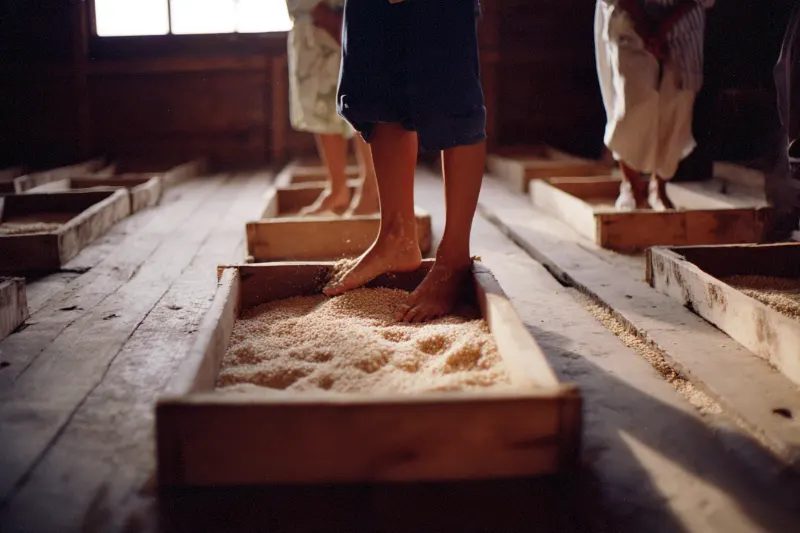
Early summer in Maotai, and the qu rooms are already brutal. The air sits at 40 to 45 °C, with humidity above 80%. In the middle of it, a group of young women in work clothes steps barefoot onto blocks of grain, pressing them into shape one foot at a time. It looks like a folk dance. It is, in fact, one of the most important jobs in the making of Moutai.
The engine before the spirit
What the women are treading is not baijiu but its starter, qu 曲 (qū). Think of it as a brick of grain colonised by moulds, yeasts and bacteria. In Europe, a brewer or whisky distiller relies on malting to turn starch into sugar, then adds yeast. In China, qu does both jobs at once: its moulds break the starch down, its yeasts turn the sugar into alcohol.
Moutai makes a style called high-temperature qu, 高温大曲 (gāowēn dàqū). The timing is deliberate. Qu-making falls around the Dragon Boat Festival, 端午 (Duānwǔ), when the wheat harvest is in and the early-summer heat and humidity give the richest population of microbes to work with. Once trodden and stacked, the blocks generate their own heat: the national heritage record describes them reaching about 62 °C as they incubate.
Moutai's official heritage text sums up its whole year in one line, and the first four characters are about this moment: 端午踩曲 (duānwǔ cǎi qū), "tread the qu at Dragon Boat".
Why feet, and why women
Machines can press qu. Across the baijiu industry, mechanical qu-making is widespread. So why does Maotai still send people barefoot into the heat?
A 2025 report in a regional newspaper put the question to the Maotai-town distilleries, and the answer was about air. A machine presses evenly, and that even pressure makes the block too dense. Too dense, and the aerobic microbes, the ones that need oxygen, are held back. A foot is never even: its curve and its shifting pressure leave tiny pores inside the block, and the microbes can breathe.
A machine presses evenly. A foot never does, and that unevenness is the whole point.
The same report explains why the treaders are young women: they are lighter, their feet are more flexible, and the blocks they make come out at the right firmness. It even lists the requirements, at least 1.58 m tall and at least 45 kg.
This needs to be read for what it is. It is the brewers' own explanation, passed down with the craft, not the result of a laboratory study. None of the sources consulted measures the difference between a block trodden by a woman, a man or a press. The official heritage text says "tread the qu" and nothing about who does the treading. And there is no reliable figure for how much of Moutai's qu is still made by foot today, or for whether women tread qu anywhere else, such as Luzhou.
Ballet among the qu
What is documented is that the practice is alive. The World of Chinese reported in 2026 that female workers still tamp the starter with bare feet each year around the Dragon Boat Festival, "a delicate task to maintain the right texture".
Moutai itself has made the treaders part of its story. A video series produced by the Moutai Group's information centre, 《人生致味》, includes an episode titled 《曲间芭蕾》, "Ballet among the qu". It follows 陈坤艳 (Chén Kūnyàn), who began treading at 19 and had been doing it for ten years. The title is well chosen: what the camera sees is balance, rhythm and repetition, in a room hot enough to make every step an effort.
For a European wine lover the obvious echo is the Portuguese lagar, where grapes for port are still trodden by foot. The logic is similar. The foot is gentler and less uniform than a machine, and the people who use it believe that difference ends up in the glass.
The qu these women make will be left to mature before it meets a single grain of sorghum. Then it becomes the starting point of Moutai's long year, and of the wider family of sauce-aroma baijiu. To understand why Chinese spirits taste the way they do, start here: with grain, heat, microbes and a pair of bare feet.
How it's made
- Mix crushed wheat with water and old qu.
- Fill wooden moulds.
- Tread the blocks barefoot, from the centre to the edges.
- Stack the blocks to incubate; they heat above 60 °C.
- Age the qu before use.
How it's drunk
The qu goes into Moutai and other sauce-aroma baijiu.
Its European cousin
Like treading grapes by foot in Portuguese lagares.