爱玲米酒
àilíng mǐjiǔ
China's makgeolli
3 min read
In 10 seconds
In China's Korean community, a fourth-generation brewer makes milky rice wine, now also with mulberries and blueberries.
In the far north-east of China lies Yanbian, 延边 (Yánbiān), in Jilin province, a homeland of China's Korean community. Here, inside a folk village built to show visitors the region's culture, a woman pours a milky rice wine she learned to make from those who came before her. It is called 爱玲米酒 (àilíng mǐjiǔ), Ailing rice wine.
Korean-Chinese, and proud of both
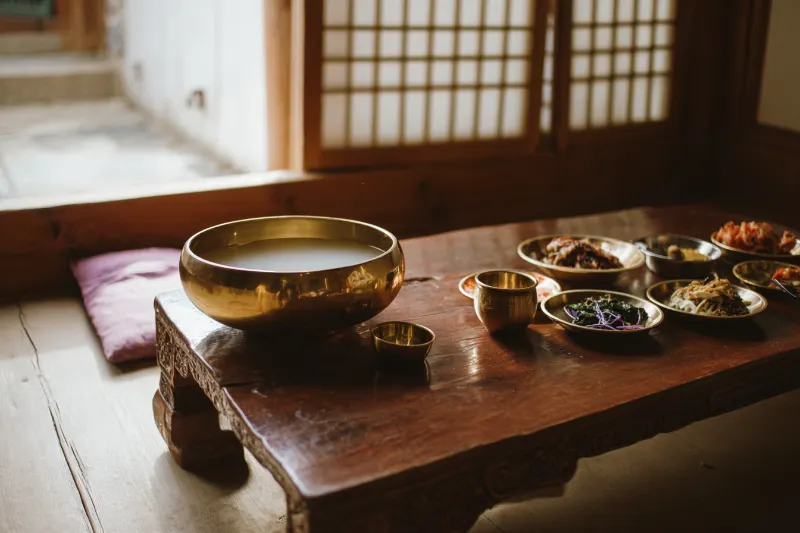
China's Korean ethnic group, the 朝鲜族 (Cháoxiǎnzú), has its own drinking traditions, and rice wine is one of them. To a European who has travelled in Korea, the style will be instantly familiar: a cloudy, rice-based drink of the makgeolli kind, served with meals and at family occasions.
The craft has a name and a lineage. A People's Daily report from October 2024 describes the brewing technique, 朝鲜族爱玲米酒制作技艺, as practised at the China Korean Ethnic Folk Village, 中国朝鲜族民俗园 (Zhōngguó Cháoxiǎnzú Mínsú Yuán), in Yanbian.
Four generations, and a fifth learning
The keeper of the craft today is 安贞今 (Ān Zhēnjīn), its fourth-generation inheritor. Her daughter is learning the trade. In a tradition where much depends on hand, eye and habit, that is the detail that matters most: a fifth pair of hands at the jar.
She has also changed the drink. Alongside the classic version, she has launched rice wines flavoured with mulberries, 桑葚 (sāngshèn), and with blueberries, 蓝莓 (lánméi). For a fourth-generation keeper, that is a bold move, and it seems to have worked. The report describes strong sales in the peak season.
A heritage drink kept alive by a mother, a daughter, and a basket of mulberries.
A living tradition in a theme park
It is important to be clear about the setting. The folk village is a cultural theme park, built for visitors. The rice wine sold there is a commercial demonstration of the craft, not a drink discovered in a private kitchen. It is, at the same time, tied to a real heritage lineage with a named inheritor.
The People's Daily report does not say at which level the craft is listed, whether county, prefecture or province. It also gives no alcohol strength, and no detailed method beyond what the style implies. Steamed rice, a starter, fermentation and straining into a milky wine is the general logic of this family of drinks, but the specific steps of the Ailing recipe are not documented in the sources.
A sommelier's curiosity
What draws a wine professional here is not rarity but evolution. Fruit additions are common in many wine cultures: think of the berry wines and fruit liqueurs of northern Europe. The mulberry and blueberry versions suggest a tradition adapting to new tastes rather than freezing in place.
No reliable tasting notes exist in the research, so none are offered here. What can be said is that the drink is sold locally and is not known to be exported. Anyone who wants to taste it will probably need to go to Yanbian.
For European readers, the best way to picture it is as China's cousin of Korean makgeolli: the same family, grown in a different country, by China's own Korean community.
Ailing rice wine is one small branch of the vast family of Chinese rice wines, which stretches from the sweet sealed-vat wines of Jiangsu to the herbal village brews of Guizhou. In Yanbian, that family speaks Korean.
How it's made
- Steam rice.
- Mix with starter and ferment.
- Strain into a milky rice wine.
- Optionally add mulberries or blueberries.
How it's drunk
With Korean-style meals and at family occasions.
Its European cousin
China's cousin of Korean makgeolli.